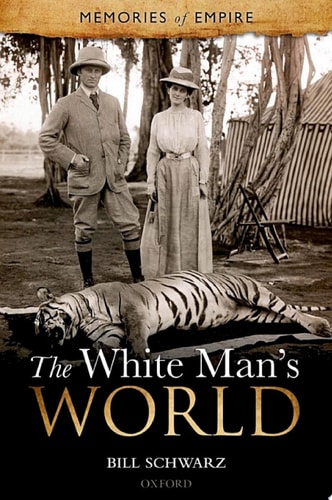
The White Man's World: Volume 2 West Indians
0
0
As an Amazon Associate and affiliate partner, Menrva Books earns from qualifying purchases. Learn more
Author Description
Memories of Empire is a trilogy which explores the complex, subterranean political currents which emerged in English society during the years of postwar decolonization. Bill Schwarz shows that, through the medium of memory, the empire was to continue to possess strange afterlives long after imperial rule itself had vanished. The White Man's World, the first volume in the trilogy, explores ideas of the white man as they evolved during the time of the British Empire, from the mid-nineteenth century to the mid-twentieth century, looking particularly at the transactions between the colonies and the home society of England. The story works back from the popular response to Enoch Powell's 'Rivers of Blood' speech in 1968, in which identifications with racial whiteness came to be highly charged. Driving this new racial politics, Bill Schwarz proposes, were unappeased memories of Britain's imperial past. The White Man's World surveys the founding of the so-called white colonies, looking in particular at Australia, South Africa, and Rhodesia, and argues that it was in this experience that contemporary meanings of racial whiteness first cohered. These colonial nations - 'white men's countries', as they were popularly known - embodied the conviction that the future of humankind lay in the hands of white men. The systems of thought which underwrote the ideas of the white man, and of the white man's country, worked as a form of ethnic populism, which gave life to the concept of Greater Britain. But if during the Victorian and Edwardian period the empire was largely narrated in heroic terms, in the masculine mode, by the time of decolonization in the 1960s racial whiteness had come to signify defeat and desperation, not only in the colonies but in the metropole too. Identifications with racial whiteness did not disappear in England in the moment of decolonization: they came alive again, fuelled by memories of what whiteness had once represented, recalling the empire as a lost rac
Menrva's Summary
THE THESIS
This work investigates how the collapse of the British Empire and the subsequent process of decolonization fundamentally reshaped English national identity and racial politics in the postwar era. Bill Schwarz, a scholar of cultural history and postcolonial studies, utilizes a framework of collective memory to analyze how imperial legacies persisted within the British metropole. He argues that the loss of colonial power did not result in the erasure of imperial ideologies, but rather their transformation into new, often volatile, forms of racial consciousness and ethnic populism.
THE SCOPE MAP
What You Will Find
- Analysis of the ideological construction of 'whiteness' within the British colonial project.
- Examination of the political and social impact of the 1968 'Rivers of Blood' speech.
- Historical survey of the development of 'white men's countries' such as Australia, South Africa, and Rhodesia.
- Theoretical exploration of the 'afterlives' of empire in domestic English society.
Scope Limits
- The text focuses primarily on the British metropole and specific settler colonies rather than a comprehensive global history of decolonization.
- It prioritizes cultural and ideological analysis over strictly economic or military history.
THE AUTHORITY PERSPECTIVE
Scholars and critics frequently highlight this work as a rigorous, intellectually dense examination of the psychological and cultural residues of the British Empire. It is widely regarded as a foundational text for those studying the intersection of postcolonial memory and contemporary British racial politics.
Page Count:
537
Publication Date:
2011-01-01
Publisher:
OUP Oxford
ISBN-10:
0191619957
ISBN-13:
9780191619953
History
Sociology
Race Relations
European History
British Empire
Community Tags
Similar Books