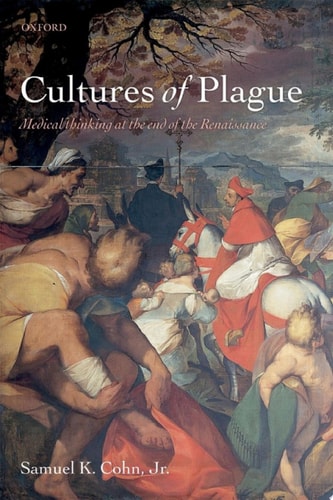
Cultures of Plague: Medical Thinking at the End of the Renaissance
0
0
As an Amazon Associate and affiliate partner, Menrva Books earns from qualifying purchases. Learn more
Author Description
Cultures of Plague opens a new chapter in the history of medicine. Neither the plague nor the ideas it stimulated were static, fixed in a timeless Galenic vacuum over five centuries, as historians and scientists commonly assume. As plague evolved in its pathology, modes of transmission, and the social characteristics of its victims, so too did medical thinking about plague develop. This study of plague imprints from academic medical treatises to plague poetry highlights the most feared and devastating epidemic of the sixteenth-century, one that threatened Italy top to toe from 1575 to 1578 and unleashed an avalanche of plague writing. From erudite definitions, remote causes, cures and recipes, physicians now directed their plague writings to the prince and discovered their most 'valiant remedies' in public health: strict segregation of the healthy and ill, cleaning streets and latrines, addressing the long-term causes of plague-poverty. Those outside the medical profession joined the chorus. In the heartland of Counter-Reformation Italy, physicians along with those outside the profession questioned the foundations of Galenic and Renaissance medicine, even the role of God. Assaults on medieval and Renaissance medicine did not need to await the Protestant-Paracelsian alliance of seventeenth-century in northern Europe. Instead, creative forces planted by the pandemic of 1575-8 sowed seeds of doubt and unveiled new concerns and ideas within that supposedly most conservative form of medical writing, the plague tract. Relying on health board statistics and dramatized with eyewitness descriptions of bizarre happenings, human misery, and suffering, these writers created the structure for plague classics of the eighteenth century, and by tracking the contagion's complex and crooked paths, they anticipated trends of nineteenth-century epidemiology.
Menrva's Summary
THE THESIS
How did the devastating plague pandemic of 1575-1578 in Italy catalyze a shift in medical thought and public health policy? Samuel K. Cohn Jr. challenges the assumption that Renaissance medical thinking remained static, arguing instead that the evolution of the plague itself forced physicians and laypeople to abandon rigid Galenic traditions in favor of practical, state-led public health interventions. By analyzing a wide array of plague tracts, poetry, and health board statistics, the author demonstrates that the seeds of modern epidemiology were sown during this period of intense crisis.
THE SCOPE MAP
What You Will Find
- Analysis of medical treatises and plague poetry from 1575-1578 Italy.
- Examination of the transition from theoretical medicine to public health administration.
- Evaluation of health board statistics and eyewitness accounts of the epidemic.
- Discussion of the questioning of Galenic and religious foundations of medicine.
Scope Limits
- The study focuses primarily on the Italian experience during the late sixteenth century.
- It does not provide a comprehensive history of plague across all of Europe or subsequent centuries.
THE AUTHORITY PERSPECTIVE
Scholars recognize this work as a significant contribution to the history of medicine that successfully refutes the notion of a stagnant Renaissance medical tradition. Readers frequently note the academic density of the prose and the author's meticulous use of primary source documents to support his historical arguments.
Page Count:
356
Publication Date:
2011-01-01
Publisher:
OUP Oxford
ISBN-10:
0191615889
ISBN-13:
9780191615887
History
Modern History
Epidemiology
European History
MEDICAL History
Public Health
Community Tags
Similar Books