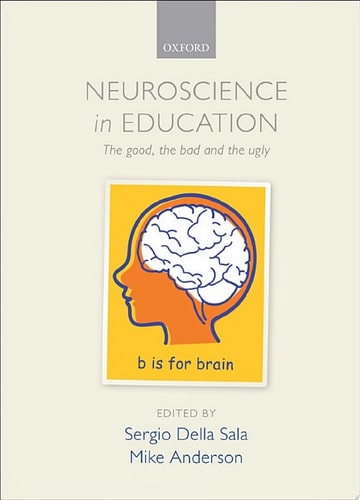
Neuroscience in Education: The Good, the Bad, and the Ugly
0
0
As an Amazon Associate and affiliate partner, Menrva Books earns from qualifying purchases. Learn more
Author Description
In the past ten years, there has been growing interest in applying our knowledge of the functioning of the human brain to the field of education-including reading, learning, language and mathematics. This has resulted in the development of a number of new practices in education-some good, some bad and some just crazy. The 'good' is nearly always sound cognitive research that has clear implications for educational practice. The 'bad' is the use of neuroscience jargon to lure the unwary and to give an apparent scientific aura to flawed educational programs with no evidence base and which no reputable neuroscientist would endorse. The 'ugly' is simplistic interpretation and misapplication of cognitive theories leading to errors in their application. More and better could be done if neuroscientists and educationalists acknowledge the limits of their disciplines and start listening to each other. Neuroscience in Education brings together an international group of leading psychologists, neuroscientists, educationalists and geneticists to critically review some of these new developments, examining the science behind these practices, the validity of the theories on which they are based, and whether they work. It will be fascinating reading for anyone involved in education, including teachers, psychologists, neuroscientists, and policy makers as well as interested parents.
Menrva's Summary
THE THESIS
This book investigates the validity and practical application of neuroscience-based interventions within modern educational systems. The authors, Mike Anderson and Sergio Della Sala, curate a collection of essays from an international panel of experts in psychology, neuroscience, and genetics. The text argues that while cognitive research offers potential benefits for learning, the field is currently plagued by the misapplication of scientific jargon and the promotion of unverified educational programs.
THE SCOPE MAP
What You Will Find
- Critical reviews of brain-based learning programs
- Analysis of the intersection between cognitive neuroscience and classroom practice
- Evaluations of reading, language, and mathematics instruction methodologies
- Discussions on the limitations of interdisciplinary collaboration
Scope Limits
- Does not provide a comprehensive manual for classroom implementation
- Does not cover every sub-field of developmental psychology
THE AUTHORITY PERSPECTIVE
Experts and educators frequently cite this text as a necessary corrective to the proliferation of pseudoscience in school curricula. Readers often note the academic rigor of the prose, which serves as a foundational resource for professionals seeking to distinguish evidence-based practice from marketing-driven educational trends.
Page Count:
402
Publication Date:
2012-01-01
Publisher:
OUP Oxford
ISBN-10:
0191629006
ISBN-13:
9780191629006
Education
Educational psychology
Allied Health
Physiological Aspects
Medical
Neurosciences
Pedagogy
Neuroscience
Community Tags
Other Editions(2)

Similar Books