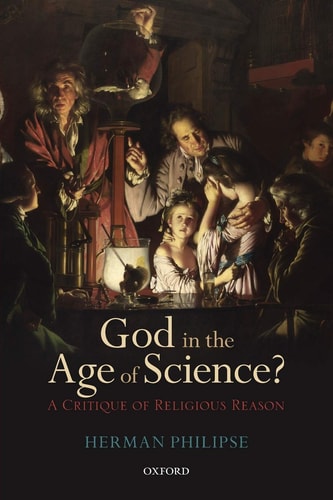
God in the Age of Science?
0
0
As an Amazon Associate and affiliate partner, Menrva Books earns from qualifying purchases. Learn more
Author Description
God in the Age of Science? is a critical examination of strategies for the philosophical defense of religious belief. The main options may be presented as the end nodes of a decision tree for religious believers. The faithful can interpret a creedal statement (e.g. 'God exists') either as a truth claim, or otherwise. If it is a truth claim, they can either be warranted to endorse it without evidence, or not. Finally, if evidence is needed, should its evidential support be assessed by the same logical criteria that we use in evaluating evidence in science, or not? Each of these options has been defended by prominent analytic philosophers of religion. In part I Herman Philipse assesses these options and argues that the most promising for believers who want to be justified in accepting their creed in our scientific age is the Bayesian cumulative case strategy developed by Richard Swinburne. Parts II and III are devoted to an in-depth analysis of this case for theism. Using a "strategy of subsidiary arguments," Philipse concludes (1) that theism cannot be stated meaningfully; (2) that if theism were meaningful, it would have no predictive power concerning existing evidence, so that Bayesian arguments cannot get started; and (3) that if the Bayesian cumulative case strategy did work, one should conclude that atheism is more probable than theism. Philipse provides a careful, rigorous, and original critique of theism in the world today.
Menrva's Summary
THE THESIS
This book investigates whether religious belief can be rationally justified within the framework of modern scientific inquiry. Herman Philipse, a professor of philosophy, utilizes a decision-tree model to categorize various strategies for defending theism. He systematically evaluates these positions, focusing specifically on the Bayesian cumulative case strategy, to determine if religious claims can withstand rigorous logical and empirical scrutiny.
THE SCOPE MAP
What You Will Find
- A decision-tree analysis of religious belief strategies
- A critical evaluation of Richard Swinburne's Bayesian cumulative case for theism
- A logical assessment of the meaningfulness and predictive power of theistic claims
Scope Limits
- The text does not address sociological or psychological aspects of religious practice
- It focuses primarily on analytic philosophy of religion rather than historical or comparative theology
THE AUTHORITY PERSPECTIVE
Scholars and students of philosophy frequently note the high level of technical rigor and academic density present in Philipse's arguments. Experts often cite this work as a significant contribution to the contemporary debate between analytic theism and atheistic philosophy.
Page Count:
0
Publication Date:
2012-01-01
Publisher:
Oxford University Press
ISBN-10:
0191629235
ISBN-13:
9780191629235
Philosophy
Religion
Proof
Religion
God
Theism
Faith and reason
Epistemology
Natural theology
Atheism
Science and Religion
Community Tags
Other Editions(2)
Similar Books