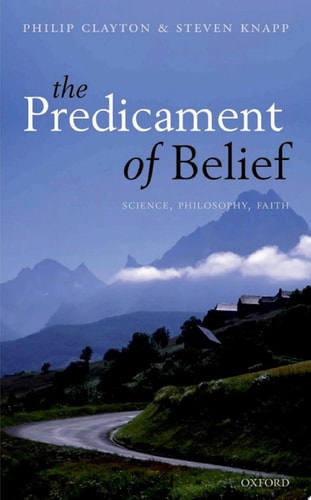
The Predicament of Belief: Science, Philosophy, and Faith
0
0
As an Amazon Associate and affiliate partner, Menrva Books earns from qualifying purchases. Learn more
Author Description
Does it make sense - can it make sense - for someone who appreciates the explanatory power of modern science to continue believing in a traditional religious account of the ultimate nature and purpose of our universe? This book is intended for those who care about that question and are dissatisfied with the rigid dichotomies that dominate the contemporary debate. The extremists won't be interested - those who assume that science answers all the questions that matter, and those so certain of their religious faith that dialogue with science, philosophy, or other faith traditions seems unnecessary. But far more people today recognize that matters of faith are complex, that doubt is endemic to belief, and that dialogue is indispensable in our day. In eight probing chapters, the authors of The Predicament of Belief consider the most urgent reasons for doubting that religious claims - in particular, those embedded in the Christian tradition - are likely to be true. They develop a version of Christian faith that preserves the tradition's core insights but also gauges the varying degrees of certainty with which those insights can still be affirmed. Along the way, they address such questions as the ultimate origin of the universe, the existence of innocent suffering, the challenge of religious plurality, and how to understand the extraordinary claim that an ancient teacher rose from the dead. They end with a discussion of what their conclusions imply about the present state and future structure of churches and other communities in which Christian affirmations are made.
Menrva's Summary
THE THESIS
This book investigates whether a coherent, intellectually honest Christian faith can be maintained by individuals who also accept the explanatory power of modern scientific inquiry. The authors, Phillip Clayton and Steven Knapp, utilize a philosophical framework to bridge the gap between rigid secularism and dogmatic fundamentalism. By examining the nature of doubt and the complexity of religious claims, they propose a nuanced approach to belief that respects both traditional Christian insights and contemporary scientific understanding.
THE SCOPE MAP
What You Will Find
- Analysis of the compatibility between Christian theology and modern scientific cosmology.
- Philosophical examination of the problem of evil and innocent suffering.
- Discussion on religious plurality and the historical claims of the resurrection.
- Proposals for the future structure of faith-based communities.
Scope Limits
- The text does not provide a comprehensive scientific textbook or a systematic theology manual.
- It does not engage with extremist perspectives that reject either science or faith entirely.
THE AUTHORITY PERSPECTIVE
Scholars and readers often categorize this work as a significant contribution to the dialogue between science and theology, noting its accessible yet rigorous philosophical tone. Experts frequently highlight the authors' ability to navigate complex epistemological challenges without resorting to simplistic resolutions.
Page Count:
194
Publication Date:
2011-01-01
Publisher:
OUP Oxford
ISBN-10:
019162067X
ISBN-13:
9780191620676
Philosophy
Religion
Apologetics
Christian Theology
Science and Religion
Science
Religion
Epistemology
Philosophy & Religion
Community Tags
Similar Books