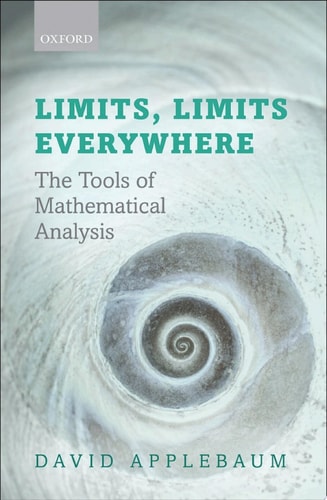
Limits, Limits Everywhere: The Tools of Mathematical Analysis
0
0
As an Amazon Associate and affiliate partner, Menrva Books earns from qualifying purchases. Learn more
Author Description
A quantity can be made smaller and smaller without it ever vanishing. This fact has profound consequences for science, technology, and even the way we think about numbers. In this book, we will explore this idea by moving at an easy pace through an account of elementary real analysis and, in particular, will focus on numbers, sequences, and series. Almost all textbooks on introductory analysis assume some background in calculus. This book doesn't and, instead, the emphasis is on the application of analysis to number theory. The book is split into two parts. Part 1 follows a standard university course on analysis and each chapter closes with a set of exercises. Here, numbers, inequalities, convergence of sequences, and infinite series are all covered. Part 2 contains a selection of more unusual topics that aren't usually found in books of this type. It includes proofs of the irrationality of e and π, continued fractions, an introduction to the Riemann zeta function, Cantor's theory of the infinite, and Dedekind cuts. There is also a survey of what analysis can do for the calculus and a brief history of the subject. A lot of material found in a standard university course on "real analysis" is covered and most of the mathematics is written in standard theorem-proof style. However, more details are given than is usually the case to help readers who find this style daunting. Both set theory and proof by induction are avoided in the interests of making the book accessible to a wider readership, but both of these topics are the subjects of appendices for those who are interested in them. And unlike most university texts at this level, topics that have featured in popular science books, such as the Riemann hypothesis, are introduced here. As a result, this book occupies a unique position between a popular mathematics book and a first year college or university text, and offers a relaxed introduction to a fascinating and important branch of mathematics.
Menrva's Summary
THE THESIS
This book investigates the foundational role of limits in mathematical analysis and their application to number theory without requiring prior calculus knowledge. David Applebaum, a mathematician and educator, presents a structured approach to real analysis that bridges the gap between popular mathematics literature and formal university-level textbooks. By focusing on the conceptual development of numbers, sequences, and series, the author provides a rigorous yet accessible framework for understanding the infinite.
THE SCOPE MAP
What You Will Find
- Coverage of real numbers, inequalities, convergence of sequences, and infinite series.
- Advanced topics including the irrationality of e and pi, continued fractions, and the Riemann zeta function.
- A historical survey of analysis and its relationship to calculus.
Scope Limits
- The text intentionally avoids set theory and formal proof by induction in the main chapters, relegating them to appendices.
- The book does not assume prior calculus experience, focusing instead on elementary real analysis.
THE AUTHORITY PERSPECTIVE
Experts note that this text serves as a unique bridge for students who find standard theorem-proof style textbooks daunting. Readers frequently highlight the book's success in making complex mathematical concepts accessible without sacrificing technical accuracy.
Page Count:
217
Publication Date:
2012-01-01
Publisher:
OUP Oxford
ISBN-10:
0191627879
ISBN-13:
9780191627873
Education
Real Analysis
Mathematics
Mathematics Statistics
Mathematical Analysis
Number Theory
textbook
Calculus
Community Tags
Similar Books