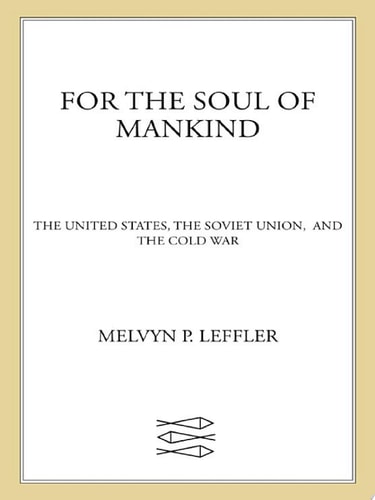
For the Soul of Mankind: The United States, the Soviet Union, and the Cold War
0
0
As an Amazon Associate and affiliate partner, Menrva Books earns from qualifying purchases. Learn more
Author Description
A masterful account of the Cold War by a distinguished historian in full stride." —G. John Ikenberry, Foreign Affairs To the amazement of the public, pundits, and even the policymakers themselves, the ideological and political battles that endangered the world for half a century came to an end in 1990. How did that happen? What caused the cold war in the first place, and why did it last as long as it did? To answer these questions, Melvyn P. Leffler homes in on four crucial episodes when American and Soviet leaders considered modulating, avoiding, or ending their global struggle "for the soul of mankind," and asks why they failed: Stalin and Truman devising new policies after 1945; Malenkov and Eisenhower exploring the chance for peace after Stalin's death in 1953; Kennedy, Khrushchev, and LBJ trying to reduce tensions after the Cuban Missile Crisis of 1962; and Brezhnev and Carter aiming to sustain détente after the Helsinki Conference of 1975. Leffler then illuminates how Reagan, Bush, and, above all, Gorbachev managed to extricate themselves form the policies and mind-sets that had imprisoned their predecessors, making it possible to reconfigure Soviet-American relations after decades of confrontation. Praise for For the Soul of Mankind "[A] sweeping work... Leffler is one of America's most distinguished cold war historians, and this enlightening, readable study is the product of years of research and reflection." —Jonathan Rosenberg, The Christian Science Monitor "Leffler has produced possibly the most readable and insightful study of the Cold War yet." — Publishers Weekly,
Menrva's Summary
THE THESIS
This book investigates the origins, duration, and eventual conclusion of the Cold War by examining pivotal moments of potential de-escalation and the underlying motivations of key leaders. Melvyn P. Leffler, a distinguished historian, analyzes four critical junctures where American and Soviet leaders considered altering or ending their global ideological struggle. The book delves into the periods following 1945 with Stalin and Truman, 1953 after Stalin's death with Malenkov and Eisenhower, 1962 post-Cuban Missile Crisis with Kennedy, Khrushchev, and LBJ, and 1975 during détente with Brezhnev and Carter. It then explores how leaders like Reagan, Bush, and Gorbachev ultimately navigated away from decades of confrontation to reconfigure Soviet-American relations.
THE SCOPE MAP
- Analysis of four crucial episodes in the Cold War where leaders considered de-escalation or peace.
- Focus on the decision-making processes of leaders such as Stalin, Truman, Malenkov, Eisenhower, Kennedy, Khrushchev, LBJ, Brezhnev, Carter, Reagan, Bush, and Gorbachev.
- Exploration of the ideological and political battles that defined the global struggle for half a century.
- Examination of the reasons behind the failure to modulate, avoid, or end the conflict during earlier periods.
- Illumination of the factors that enabled leaders like Reagan and Gorbachev to reconfigure Soviet-American relations.
- Historical context provided by a distinguished Cold War historian.
- Insights into the causes and duration of the Cold War.
THE AUTHORITY PERSPECTIVE
Melvyn P. Leffler's "For the Soul of Mankind" is lauded as a masterful and insightful account of the Cold War. Critics highlight its sweeping scope and the author's distinguished expertise in the field, noting that it is the product of years of research and reflection. The book is praised for its readability and its ability to illuminate the complex dynamics that shaped global relations for decades. It is considered by some to be possibly the most readable and insightful study of the Cold War yet published.
Page Count:
608
Publication Date:
2008-09-02
Publisher:
Hill and Wang
ISBN-10:
142996409X
ISBN-13:
9781429964098
Non-Fiction
Politics
History
International relations
Community Tags
Similar Books