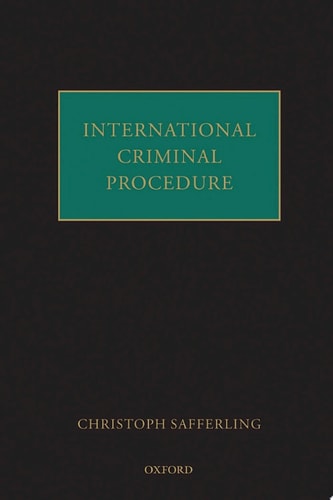
International Criminal Procedure
0
0
As an Amazon Associate and affiliate partner, Menrva Books earns from qualifying purchases. Learn more
Author Description
This book sets out and analyses the procedural law applied by international criminal tribunals and the International Criminal Court (ICC). It traces the development of international criminal procedure from its roots in the International Military Tribunal at Nuremberg to its current application by the Yugoslav and Rwanda Tribunals, the Special Court for Sierra Leone, the Extraordinary Chamber in the Courts of Cambodia, and the International Criminal Court. All of these tribunals apply a different set of rules. The focus of this book, however, lies on the ICC and its procedural regime as contained in the Rome Statute, the Rules of Procedure and Evidence, and the different Regulations of the Court and of the Prosecutor. The exceptional compromise between common and civil law which formed the basis of the ICC's Statute created a unique procedural order. This book systematically analyses the Court's organisational structure, overall procedural setting, and the individual procedural regulations, and compares and contrasts these to other international criminal tribunals. Amongst the many unresolved procedural issues are the rights of the accused before, during, and after the trial, the disclosure of evidence, the presentation of evidence, the participation of victims, the protection of witnesses, and the cooperation between the ICC and individual states. Through looking at these issues, the book develops a concise and fitting theoretical underpinning for the ICC's procedural order that is not founded on any specific legal culture.
Menrva's Summary
THE THESIS
This book investigates the procedural framework of international criminal tribunals, specifically focusing on the unique legal synthesis established by the International Criminal Court (ICC). Christoph J. M. Safferling, a scholar in international criminal law, utilizes the historical evolution of tribunals—from Nuremberg to the ICC—to analyze the procedural challenges inherent in blending common and civil law traditions. The work provides a systematic examination of the Rome Statute and the associated rules of evidence, arguing for a theoretical foundation that transcends individual national legal cultures.
THE SCOPE MAP
What You Will Find
- Comparative analysis of procedural rules across the ICTY, ICTR, SCSL, ECCC, and ICC
- Examination of the Rome Statute and the Rules of Procedure and Evidence
- Analysis of victim participation, witness protection, and state cooperation mechanisms
Scope Limits
- Does not provide a comprehensive history of substantive international criminal law
- Does not offer a manual for courtroom litigation practice
THE AUTHORITY PERSPECTIVE
Legal scholars and practitioners frequently cite this work for its rigorous systematic analysis of the ICC's procedural regime. Experts highlight the text as a foundational resource for understanding the complex intersection of diverse legal traditions within international justice systems.
Page Count:
554
Publication Date:
2012-01-01
Publisher:
OUP Oxford
ISBN-10:
0191627739
ISBN-13:
9780191627736
Professional Career & Trade
International Law
Criminal Law
Human rights
Law
Community Tags
Similar Books