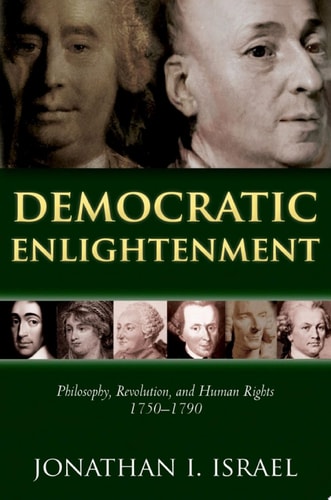
Democratic Enlightenment: Philosophy, Revolution, and Human Rights 1750-1790
0
0
As an Amazon Associate and affiliate partner, Menrva Books earns from qualifying purchases. Learn more
Author Description
The Enlightenment shaped modernity. Western values of representative democracy and basic human rights, gender and racial equality, individual liberty, and freedom of expression and the press, form an interlocking system that derives directly from the Enlightenment's philosophical revolution. This fact is uncontested - yet remarkably few historians or philosophers have attempted to trace the process of ideas from the political and social turmoil of the late eighteenth century to the present day. This is precisely what Jonathan Israel now does. He demonstrates that the Enlightenment was an essentially revolutionary process, driven by philosophical debate. From 1789, its impetus came from a small group of philosophe-revolutionnaires, men such as Mirabeau, Sieyes, Condorcet, Volney, Roederer, and Brissot. Not aligned to any of the social groups who took the lead in the French National assembly, the Paris commune, or the editing of the Parisian revolutionary journals, they nonetheless forged 'la philosophie moderne' -- in effect Radical Enlightenment ideas -- into a world-transforming ideology that had a lasting impact in Latin America and eastern Europe as well as France, Italy, Germany, and the Low Countries. Whilst all French revolutionary journals clearly stated that la philosophie moderne was the main cause of the French Revolution, the main stream of historical thought has failed to grasp what this implies. Israel sets the record straight, demonstrating the true nature of the engine that drove the Revolution, and the intimate links between the radical wing of the Enlightenment and the anti-Robespierriste 'Revolution of reason'.
Menrva's Summary
THE THESIS
This work investigates how the radical philosophical ideas of the Enlightenment served as the primary engine for the political and social transformations of the late eighteenth century. Jonathan Israel, a prominent historian of the Enlightenment, utilizes extensive archival research and analysis of revolutionary-era journals to argue that modern democratic values—including human rights, individual liberty, and equality—originated from a specific, radical intellectual movement. He posits that these ideas were not merely secondary to social turmoil but were the central drivers of the revolutionary process in France and beyond.
THE SCOPE MAP
What You Will Find
- Analysis of the intellectual contributions of figures such as Mirabeau, Sieyes, Condorcet, and Brissot.
- Examination of the influence of 'la philosophie moderne' on political movements in France, Italy, Germany, and Latin America.
- Historical reconstruction of the ideological divide between the Radical Enlightenment and the Robespierriste faction.
Scope Limits
- The text focuses primarily on the intellectual history of the period 1750-1790 rather than a comprehensive military or social history of the French Revolution.
- It does not provide an exhaustive analysis of non-Western political developments during this timeframe.
THE AUTHORITY PERSPECTIVE
Scholars frequently note the academic density and rigorous detail of Israel's prose, which challenges traditional historiographical interpretations of the Enlightenment. Experts often cite this text as a foundational, albeit demanding, resource for understanding the intellectual origins of modern representative democracy.
Page Count:
1083
Publication Date:
2011-01-01
Publisher:
OUP Oxford
ISBN-10:
0191620041
ISBN-13:
9780191620041
History
Philosophy
French Revolution
European History
Intellectual History
Community Tags
Similar Books