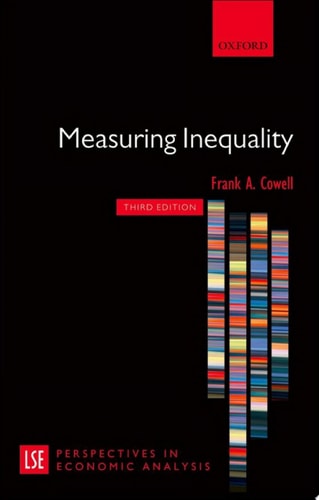
Measuring Inequality
0
0
As an Amazon Associate and affiliate partner, Menrva Books earns from qualifying purchases. Learn more
Author Description
What do we mean by inequality comparisons? If the rich just get richer and the poor get poorer, the answer might seem easy. But what if the income distribution changes in a complicated way? Can we use mathematical or statistical techniques to simplify the comparison problem in a way that has economic meaning? What does it mean to measure inequality? Is it similar to National Income? Or a price index? Is it enough just to work out the Gini coefficient? Measuring Inequality tackles these questions and examines the underlying principles of inequality measurement and its relation to welfare economics, distributional analysis, and information theory. The book covers modern theoretical developments in inequality analysis, as well as showing how the way we think about inequality today has been shaped by classic contributions in economics and related disciplines. Formal results and detailed literature discussion are provided in two appendices. The principal points are illustrated in the main text, using examples from US and UK data, as well as other data sources, and associated web materials provide hands-on learning. Measuring Inequality is designed to appeal to both undergraduate and post-graduate students, and academic economists. Its emphasis on practical application means that it will also be useful to policy analysts and advisors.
Menrva's Summary
THE THESIS
This book investigates the theoretical foundations and practical methodologies required to quantify economic inequality within a population. Frank A. Cowell, a professor at the London School of Economics, utilizes his extensive background in distributional analysis to bridge the gap between abstract mathematical indices and real-world economic welfare. The text argues that inequality measurement is not merely a statistical exercise but a complex intersection of welfare economics, information theory, and policy-oriented analysis.
THE SCOPE MAP
What You Will Find
- Mathematical and statistical frameworks for inequality comparison
- Analysis of classic economic contributions alongside modern theoretical developments
- Practical application of indices using US and UK datasets
Scope Limits
- Does not provide a singular, definitive policy recommendation for all economic systems
- Requires a foundational understanding of economic theory and statistical notation
THE AUTHORITY PERSPECTIVE
Experts and academics frequently cite this work as a foundational text for understanding the rigorous mechanics of distributional analysis. Readers often note the high level of technical density, making it a standard reference for students and policy analysts working within the field of welfare economics.
Page Count:
252
Publication Date:
2011-01-01
Publisher:
OUP Oxford
ISBN-10:
0191625124
ISBN-13:
9780191625121
Economics
Social Science
Statistics
Public Policy
Community Tags
Similar Books