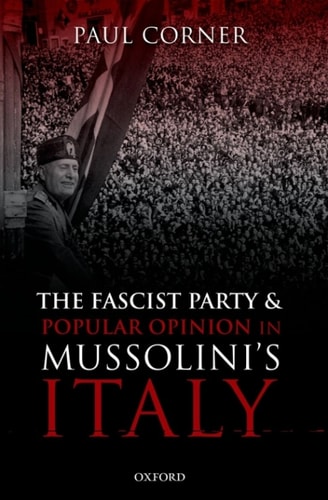
The Fascist Party and Popular Opinion in Mussolini's Italy
0
0
As an Amazon Associate and affiliate partner, Menrva Books earns from qualifying purchases. Learn more
Author Description
The question of how ordinary people related to totalitarian regimes is still far from being answered. The tension between repression and consensus makes analysis difficult; where one ends and the other begins is never easy to determine. In the case of fascist Italy, recent scholarship has tended to tilt the balance in favour of popular consensus for the regime, identifying in the novel ideological and cultural aspects of Mussolini's rule a 'political religion' which bound the population to the fascist leader. The Party and the People presents a different picture. While not underestimating the force of ideological factors, Paul Corner argues that 'real existing Fascism', as lived by a large part of the population, was in fact an increasingly negative experience and reflected few of those colourful and attractive features of fascist propaganda which have induced more favourable interpretations of the regime. Distinguishing clearly between the fascist project and its realisation, Corner examines the ways in which the fascist party asserted itself at the local level in the widely-differing areas of Italy, at its corruption and malfunctioning, and at the mounting wave of popular resentment against it during the course of the 1930s - resentment and hostility which, in effect, signalled the failure of the project. The Party and the People, based largely on unpublished archival material, concludes by suggesting that the abuse of power by fascists mirrors much wider problems in Italy related to the relationship between the public and the private and to the modes of utilisation of power, both in the past and in the present.
Menrva's Summary
THE THESIS
This book investigates the discrepancy between the ideological project of Mussolini's regime and the lived reality of the Italian population during the 1930s. Paul Corner, a historian specializing in modern Italian history, utilizes extensive unpublished archival material to challenge the narrative of widespread popular consensus. He argues that the fascist party's local-level corruption and systemic failure created a pervasive sense of resentment that undermined the regime's propaganda efforts.
THE SCOPE MAP
What You Will Find
- Analysis of the fascist party's operational failures at the local level across diverse Italian regions.
- Examination of the tension between state-sponsored 'political religion' and actual public sentiment.
- Documentation of systemic corruption and the abuse of power within the party hierarchy.
Scope Limits
- The study focuses primarily on the 1930s rather than the entire duration of the fascist regime.
- The analysis prioritizes the internal mechanics of the party over international diplomatic relations.
THE AUTHORITY PERSPECTIVE
Historians and scholars of the period frequently cite this work as a critical counter-narrative to interpretations that emphasize popular support for Mussolini. Readers often note the academic density of the prose and the rigorous reliance on primary archival sources to support the author's conclusions.
Page Count:
808
Publication Date:
2012-01-01
Publisher:
OUP Oxford
ISBN-10:
0191630616
ISBN-13:
9780191630613
History
Italian History
Fascism
European History
Fascism italy
Italy history
Community Tags
Similar Books