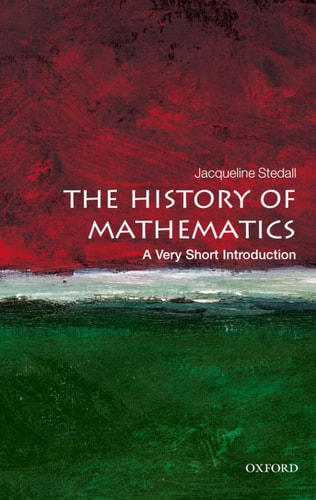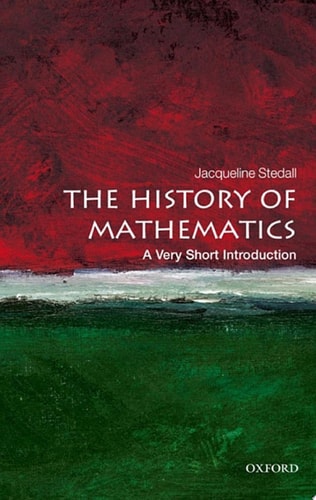
The History of Mathematics: A Very Short Introduction
0
0
As an Amazon Associate and affiliate partner, Menrva Books earns from qualifying purchases. Learn more
Author Description
Mathematics is a fundamental human activity that can be practised and understood in a multitude of ways; indeed, mathematical ideas themselves are far from being fixed, but are adapted and changed by their passage across periods and cultures. In this Very Short Introduction, Jacqueline Stedall explores the rich historical and cultural diversity of mathematical endeavour from the distant past to the present day. Arranged thematically, to exemplify the varied contexts in which people have learned, used, and handed on mathematics, she also includes illustrative case studies drawn from a range of times and places, including early imperial China, the medieval Islamic world, and nineteenth-century Britain. ABOUT THE SERIES: The Very Short Introductions series from Oxford University Press contains hundreds of titles in almost every subject area. These pocket-sized books are the perfect way to get ahead in a new subject quickly. Our expert authors combine facts, analysis, perspective, new ideas, and enthusiasm to make interesting and challenging topics highly readable.
Menrva's Summary
THE THESIS
This book investigates how mathematical ideas evolve across different cultures and time periods, challenging the notion that mathematics is a static or fixed discipline. Jacqueline A. Stedall, a respected historian of mathematics, utilizes a thematic framework to demonstrate that mathematical practice is deeply embedded in the social and cultural contexts of its creators. By moving away from a strictly chronological approach, she highlights the diverse ways human societies have engaged with numerical and geometric concepts throughout history.
THE SCOPE MAP
What You Will Find
- Thematic analysis of mathematical development across global civilizations
- Case studies from imperial China, the medieval Islamic world, and nineteenth-century Britain
- Exploration of how mathematical knowledge is transmitted and adapted
Scope Limits
- Does not provide a comprehensive, year-by-year timeline of mathematical discovery
- Does not focus on advanced technical proofs or complex modern mathematical theory
THE AUTHORITY PERSPECTIVE
Experts and readers frequently note that this text serves as an accessible entry point for those interested in the cultural history of mathematics. The prose is praised for its clarity and ability to distill complex historical trends into a concise, readable format.
Page Count:
145
Publication Date:
2012-01-01
Publisher:
OUP Oxford
ISBN-10:
0191633968
ISBN-13:
9780191633966
Non-Fiction
History
Science
Education
Mathematics - General
Mathematics Statistics
Mathematics