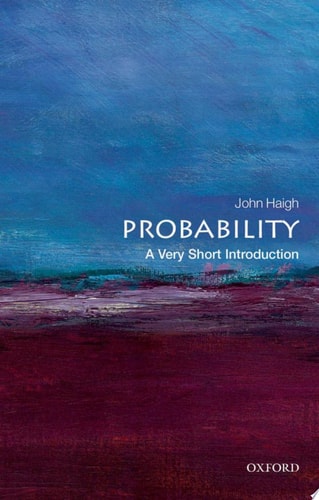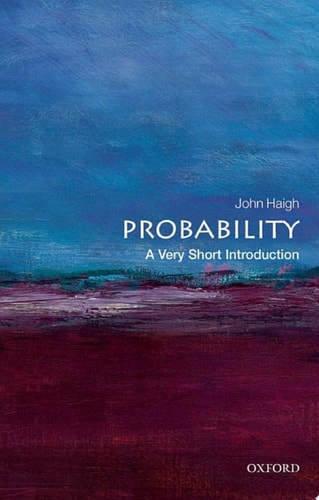
Probability: A Very Short Introduction
0
0
As an Amazon Associate and affiliate partner, Menrva Books earns from qualifying purchases. Learn more
Author Description
Making good decisions under conditions of uncertainty - which is the norm - requires a sound appreciation of the way random chance works. As analysis and modelling of most aspects of the world, and all measurement, are necessarily imprecise and involve uncertainties of varying degrees, the understanding and management of probabilities is central to much work in the sciences and economics. In this Very Short Introduction, John Haigh introduces the ideas of probability and different philosophical approaches to probability, and gives a brief account of the history of development of probability theory, from Galileo and Pascal to Bayes, Laplace, Poisson, and Markov. He describes the basic probability distributions, and goes on to discuss a wide range of applications in science, economics, and a variety of other contexts such as games and betting. He concludes with an intriguing discussion of coincidences and some curious paradoxes. ABOUT THE SERIES: The Very Short Introductions series from Oxford University Press contains hundreds of titles in almost every subject area. These pocket-sized books are the perfect way to get ahead in a new subject quickly. Our expert authors combine facts, analysis, perspective, new ideas, and enthusiasm to make interesting and challenging topics highly readable.
Menrva's Summary
THE THESIS
This book investigates the fundamental principles of probability and how they function as a framework for decision-making under conditions of uncertainty. John Haigh, a mathematician with extensive experience in the field, utilizes historical context and practical examples to explain how random chance influences scientific measurement and economic modeling. The text provides a structured overview of probability theory, moving from foundational concepts to complex applications in real-world scenarios.
THE SCOPE MAP
What You Will Find
- Historical development of probability theory from Galileo to Markov
- Explanations of basic probability distributions
- Analysis of probability applications in science, economics, and gambling
- Discussion of statistical paradoxes and the nature of coincidences
Scope Limits
- Does not provide advanced mathematical proofs or rigorous derivations
- Does not serve as a comprehensive textbook for specialized statistical research
THE AUTHORITY PERSPECTIVE
Experts and readers recognize this work as an accessible entry point for those seeking a conceptual understanding of probability without overwhelming technical jargon. The text is frequently cited for its ability to distill complex mathematical history and theory into a concise, readable format.
Page Count:
145
Publication Date:
2012-01-01
Publisher:
OUP Oxford
ISBN-10:
0191636835
ISBN-13:
9780191636837
Non-Fiction
Science
Statistics
Mathematics Statistics
Mathematics
Probability