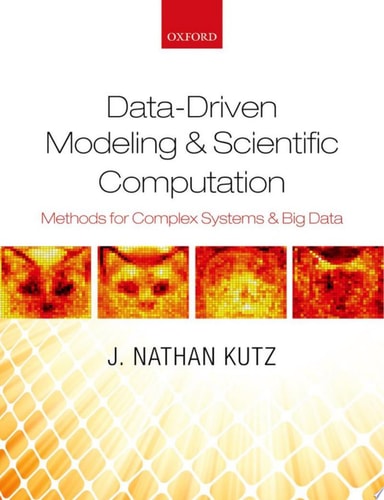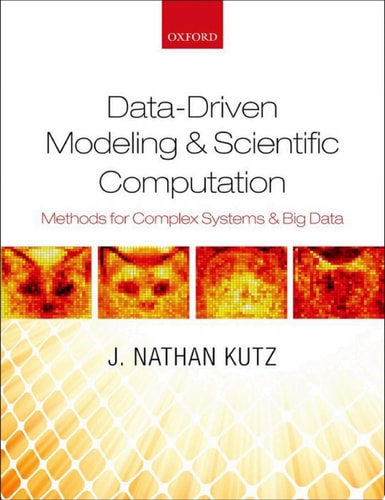
Data-Driven Modeling & Scientific Computation: Methods for Complex Systems & Big Data
0
0
As an Amazon Associate and affiliate partner, Menrva Books earns from qualifying purchases. Learn more
Author Description
The burgeoning field of data analysis is expanding at an incredible pace due to the proliferation of data collection in almost every area of science. The enormous data sets now routinely encountered in the sciences provide an incentive to develop mathematical techniques and computational algorithms that help synthesize, interpret and give meaning to the data in the context of its scientific setting. A specific aim of this book is to integrate standard scientific computing methods with data analysis. By doing so, it brings together, in a self-consistent fashion, the key ideas from: · statistics, · time-frequency analysis, and · low-dimensional reductions The blend of these ideas provides meaningful insight into the data sets one is faced with in every scientific subject today, including those generated from complex dynamical systems. This is a particularly exciting field and much of the final part of the book is driven by intuitive examples from it, showing how the three areas can be used in combination to give critical insight into the fundamental workings of various problems. Data-Driven Modeling and Scientific Computation is a survey of practical numerical solution techniques for ordinary and partial differential equations as well as algorithms for data manipulation and analysis. Emphasis is on the implementation of numerical schemes to practical problems in the engineering, biological and physical sciences. An accessible introductory-to-advanced text, this book fully integrates MATLAB and its versatile and high-level programming functionality, while bringing together computational and data skills for both undergraduate and graduate students in scientific computing.
Menrva's Summary
THE THESIS
This text investigates how to integrate traditional scientific computing methods with modern data analysis techniques to interpret complex systems. Author J. Nathan Kutz, a professor of applied mathematics, provides a framework for synthesizing large data sets using statistical methods, time-frequency analysis, and low-dimensional reductions. The book argues that combining these computational skills is necessary for extracting meaning from data generated in engineering, biological, and physical sciences.
THE SCOPE MAP
What You Will Find
- Numerical solution techniques for ordinary and partial differential equations
- Algorithms for data manipulation and analysis
- Integration of MATLAB programming for practical implementation
- Case studies from complex dynamical systems
Scope Limits
- Does not provide a comprehensive survey of pure theoretical mathematics
- Does not cover non-MATLAB-based computational environments
THE AUTHORITY PERSPECTIVE
Experts and educators frequently cite this work as a bridge between undergraduate numerical analysis and advanced graduate-level data science. Readers often note the practical utility of the MATLAB-integrated approach for students working in applied scientific fields.
Page Count:
657
Publication Date:
2013-01-01
Publisher:
OUP Oxford
ISBN-10:
019163588X
ISBN-13:
9780191635885
Science
Mathematics
Mathematics Statistics
Multivariate analysis
Engineering
Data Science
Numerical analysis
Mathematics - General
Community Tags
Similar Books