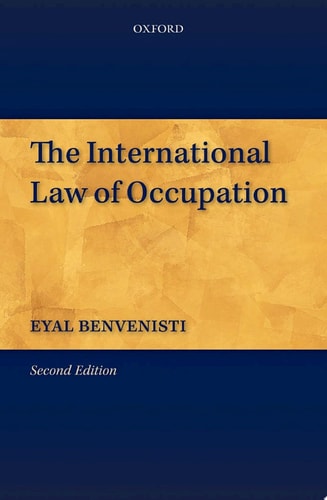
The International Law of Occupation
0
0
As an Amazon Associate and affiliate partner, Menrva Books earns from qualifying purchases. Learn more
Author Description
The law of occupation imposes two types of obligations on an army that seizes control of enemy land during armed conflict: obligations to respect and protect the inhabitants and their rights, and an obligation to respect the sovereign rights of the ousted government. In theory, the occupant is expected to establish an effective and impartial administration, to carefully balance its own interests against those of the inhabitants and their government, and to negotiate the occupation's early termination in a peace treaty. Although these expectations have been proven to be too high for most occupants, they nevertheless serve as yardsticks that measure the level of compliance of the occupants with international law. This thoroughly revised edition of the 1993 book traces the evolution of the law of occupation from its inception during the 18th century until today. It offers an assessment of the law by focusing on state practice of the various occupants and reactions thereto, and on the governing legal texts and judicial decisions. The underlying thought that informs and structures the book suggests that this body of laws has been shaped by changing conceptions about war and sovereignty, by the growing attention to human rights and the right to self-determination, as well as by changes in the balance of power among states. Because the law of occupation indirectly protects the sovereign, occupation law can be seen as the mirror-image of the law on sovereignty. Shifting perceptions on sovereign authority are therefore bound to be reflected also in the law of occupation, and vice-versa.
Menrva's Summary
THE THESIS
This book investigates the evolution and application of the international law of occupation, questioning how legal frameworks balance the rights of inhabitants against the interests of occupying powers. Eyal Benvenisti, a professor of international law, utilizes historical state practice, judicial decisions, and governing legal texts to argue that occupation law is a mirror-image of evolving concepts of sovereignty. He posits that the effectiveness of these laws is contingent upon shifting global perceptions of human rights and the balance of power between states.
THE SCOPE MAP
What You Will Find
- Historical analysis of occupation law from the 18th century to the present.
- Examination of the dual obligations of occupying armies: protecting inhabitants and respecting the ousted government's sovereignty.
- Assessment of state practice and international reactions to various historical occupations.
Scope Limits
- The text does not provide a manual for military field operations.
- It does not offer exhaustive case studies for every occupation in modern history.
THE AUTHORITY PERSPECTIVE
Legal scholars and practitioners frequently cite this work as a foundational text for understanding the intersection of sovereignty and military occupation. Readers often note the academic density of the prose, which is tailored for students and professionals in the field of international law.
Page Count:
416
Publication Date:
2012-01-01
Publisher:
OUP Oxford
ISBN-10:
0191639575
ISBN-13:
9780191639579
Law
Professional Career & Trade
Sovereignty
Human rights
International Law
Military History
Community Tags
Other Editions(5)



Similar Books










Reader Comments
Share Your Thoughts
No comments yet. Be the first to share your thoughts!