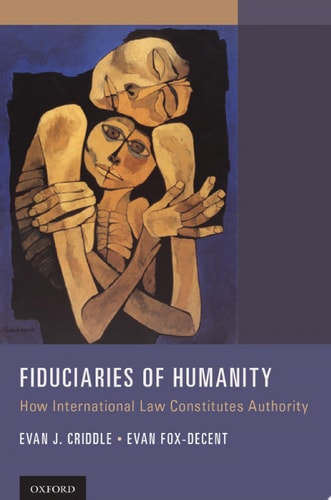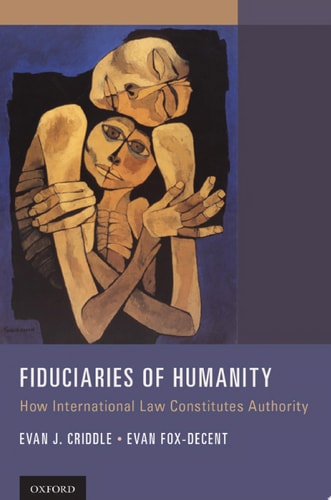
Fiduciaries of Humanity: How International Law Constitutes Authority
0
0
As an Amazon Associate and affiliate partner, Menrva Books earns from qualifying purchases. Learn more
Author Description
Public international law has embarked on a new chapter. Over the past century, the classical model of international law, which emphasized state autonomy and interstate relations, has gradually ceded ground to a new model. Under the new model, a state's sovereign authority arises from the state's responsibility to respect, protect, and fulfill human rights for its people. In Fiduciaries of Humanity: How International Law Constitutes Authority, Evan J. Criddle and Evan Fox-Decent argue that these developments mark a turning point in the international community's conception of public authority. Under international law today, states serve as fiduciaries of humanity, and their authority to govern and represent their people is dependent on their satisfaction of numerous duties, the most general of which is to establish a regime of secure and equal freedom on behalf of the people subject to their power. International institutions also serve as fiduciaries of humanity and are subject to similar fiduciary obligations. In contrast to the receding classical model of public international law, which assumes an abiding tension between a state's sovereignty and principles of state responsibility, the fiduciary theory reconciles state sovereignty and responsibility by explaining how a state's obligations to its people are constitutive of its legal authority under international law. The authors elaborate and defend the fiduciary model while exploring its application to a variety of current topics and controversies, including human rights, emergencies, the treatment of detainees in counterterrorism operations, humanitarian intervention, and the protection of refugees fleeing persecution.
Menrva's Summary
THE THESIS
This book investigates the evolving nature of public international law by proposing that state sovereignty is fundamentally derived from a fiduciary obligation to protect human rights. Authors Evan Fox-Decent and Evan J. Criddle, both scholars of legal theory and international law, argue that the classical model of state autonomy is being replaced by a framework where authority is contingent upon a state's commitment to secure and equal freedom for its subjects. By synthesizing legal philosophy with contemporary international practice, the authors demonstrate how this fiduciary model reconciles the historical tension between sovereign power and international responsibility.
THE SCOPE MAP
What You Will Find
- A comprehensive theoretical framework defining states and international institutions as fiduciaries of humanity.
- An analysis of the shift from state-centric autonomy to human rights-based legitimacy.
- Application of fiduciary theory to modern controversies including counterterrorism, humanitarian intervention, and refugee protection.
- A legal argument reconciling the inherent duties of governance with the exercise of sovereign authority.
THE AUTHORITY PERSPECTIVE
Legal scholars and practitioners identify this work as a significant contribution to the discourse on international legal theory. Readers frequently note the academic density of the prose, which serves as a rigorous examination of the normative foundations of global governance.
Page Count:
392
Publication Date:
2016-09-05
Publisher:
Oxford University Press
ISBN-10:
0199397929
ISBN-13:
9780199397921
Human rights
International Law
Professional Career & Trade
Authority
Law
Sovereignty