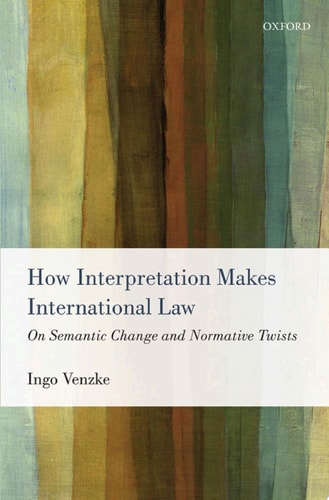
How Interpretation Makes International Law: On Semantic Change and Normative Twists
0
0
As an Amazon Associate and affiliate partner, Menrva Books earns from qualifying purchases. Learn more
Author Description
Challenging the classic narrative that sovereign states make the law that constrains them, this book argues that treaties and other sources of international law form only the starting point of legal authority. Interpretation can shift the meaning of texts and, in its own way, make law. In the practice of interpretation actors debate the meaning of the written and customary laws, and so contribute to the making of new law. In such cases it is the actor's semantic authority that is key - the capacity for their interpretation to be accepted and become established as new reference points for legal discourse. The book identifies the practice of interpretation as a significant space for international lawmaking, using the key examples of the UN High Commissioner for Refugees and the Appellate Body of the WTO to show how international institutions are able to shape and develop their constituent instruments by adding layers of interpretation, and moving the terms of discourse. The book applies developments in linguistics to the practice of international legal interpretation, building on semantic pragmatism to overcome traditional explanations of lawmaking and to offer a fresh account of how the practice of interpretation makes international law. It discusses the normative implications that arise from viewing interpretation in this light, and the implications that the importance of semantic changes has for understanding the development of international law. The book tests the potential of international law and its doctrine to respond to semantic change, and ultimately ponders how semantic authority can be justified democratically in a normative pluriverse.
Menrva's Summary
THE THESIS
This book investigates how the practice of interpretation functions as a primary mechanism for the creation and evolution of international law, challenging the traditional view that law is solely the product of sovereign state consent. Ingo Venzke, a scholar of international law, utilizes a framework grounded in semantic pragmatism to analyze how legal actors exert semantic authority. By examining how the meaning of treaties and customary laws shifts through discourse, Venzke argues that interpretation is not merely a secondary application of law but a creative act that establishes new legal reference points.
THE SCOPE MAP
What You Will Find
- Analysis of semantic pragmatism applied to international legal discourse
- Case studies of the UN High Commissioner for Refugees and the WTO Appellate Body
- Examination of the democratic legitimacy of semantic authority in a normative pluriverse
- Theoretical framework for understanding how institutions shape constituent instruments
Scope Limits
- The text does not provide a comprehensive history of all international legal institutions
- It does not offer a manual for practical litigation strategies in specific courts
THE AUTHORITY PERSPECTIVE
Legal scholars and practitioners frequently cite this work for its sophisticated integration of linguistic theory into the study of international law. Experts highlight the text as a significant contribution to the understanding of institutional power and the evolution of legal norms beyond traditional state-centric models.
Page Count:
337
Publication Date:
2012-01-01
Publisher:
OUP Oxford
ISBN-10:
0191631965
ISBN-13:
9780191631962
Linguistics
Legal Theory
Professional Career & Trade
Jurisprudence
International Law
Community Tags
Similar Books