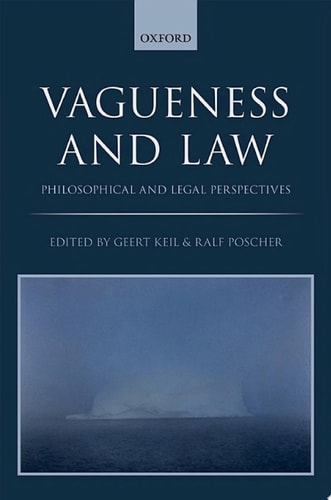
Vagueness and Law: Philosophical and Legal Perspectives
0
0
As an Amazon Associate and affiliate partner, Menrva Books earns from qualifying purchases. Learn more
Author Description
Vague expressions are omnipresent in natural language. As such, their use in legal texts is virtually inevitable. If a law contains vague terms, the question whether it applies to a particular case often lacks a clear answer. One of the fundamental pillars of the rule of law is legal certainty. The determinacy of the law enables people to use it as a guide and places judges in the position to decide impartially. Vagueness poses a threat to these ideals. In borderline cases, the law seems to be indeterminate and thus incapable of serving its core rule of law value. In the philosophy of language, vagueness has become one of the hottest topics of the last two decades. Linguists and philosophers have investigated what distinguishes "soritical " vagueness from other kinds of linguistic indeterminacy, such as ambiguity, generality, open texture, and family resemblance concepts. There is a vast literature that discusses the logical, semantic, pragmatic, and epistemic aspects of these phenomena. Legal theory has hitherto paid little attention to the differences between the various kinds of linguistic indeterminacy that are grouped under the heading of "vagueness ", let alone to the various theories that try to account for these phenomena. Bringing together leading scholars working on the topic of vagueness in philosophy and in law, this book fosters a dialogue between philosophers and legal scholars by examining how philosophers conceive vagueness in law from their theoretical perspective and how legal theorists make use of philosophical theories of vagueness. The chapters of the book are organized into three parts. The first part addresses the import of different theories of vagueness for the law, referring to a wide range of theories from supervaluationist to contextualist and semantic realist accounts in order to address the question of whether the law can learn from engaging with philosophical discussions of vagueness. The second part of the book examines different vagu
Menrva's Summary
THE THESIS
This volume investigates how the inherent vagueness of natural language challenges the foundational legal principle of legal certainty. The authors, Geert Keil and Ralf Poscher, curate a collection of essays from leading philosophers and legal scholars to bridge the gap between linguistic theory and legal practice. By analyzing various forms of indeterminacy, the text evaluates whether philosophical frameworks—such as supervaluationism and contextualism—can provide practical solutions for judicial decision-making and the interpretation of vague legal statutes.
THE SCOPE MAP
What You Will Find
- Comparative analysis of linguistic indeterminacy including ambiguity, generality, and open texture.
- Application of philosophical theories like supervaluationism and contextualism to legal contexts.
- Multi-disciplinary dialogue between academic philosophers and legal theorists.
Scope Limits
- The text does not provide a universal manual for drafting unambiguous legislation.
- It does not focus on specific regional legal codes, but rather on the theoretical underpinnings of legal language.
THE AUTHORITY PERSPECTIVE
Experts identify this work as a significant contribution to the intersection of analytical philosophy and jurisprudence. Readers frequently note the academic density of the prose, which is intended for scholars and advanced students of legal theory.
Page Count:
350
Publication Date:
2016-01-01
Publisher:
OUP Oxford
ISBN-10:
0191085715
ISBN-13:
9780191085710
Philosophy
Interpretation and construction
Vagueness Philosophy
Legal Theory
Law Jurisprudence
Jurisprudence
Linguistics
Law
Professional Career & Trade
Philosophy of
Community Tags
Other Editions(2)

Similar Books
Reader Comments
Share Your Thoughts
No comments yet. Be the first to share your thoughts!