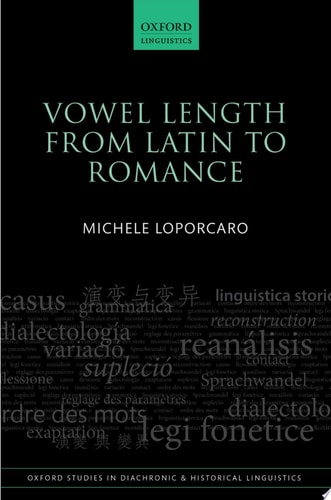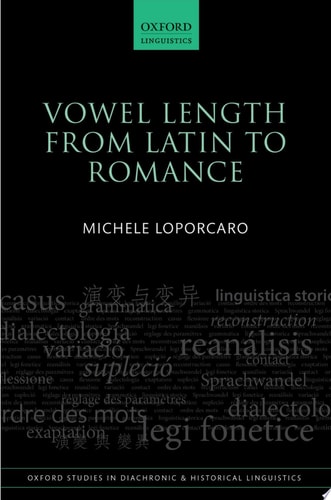
Vowel Length From Latin to Romance
0
0
As an Amazon Associate and affiliate partner, Menrva Books earns from qualifying purchases. Learn more
Author Description
This book investigates the changes that affected vowel length during the development of Latin into the Romance languages and dialects. In Latin, vowel length was contrastive (e.g. pila 'ball' vs. pila 'pile', like English bit vs. beat), but no modern Romance language has retained that same contrast. However, many non-standard Romance dialects (as well as French, up to the early 20th century) have developed novel vowel length contrasts, which are investigated in detail here. Unlike previous studies of this phenomenon, this book combines detailed historical evidence spanning three millennia (as attested by extant texts) with extensive data from present-day Romance varieties collected from first-hand fieldwork, which are subjected to both phonological and experimental phonetic analysis. Professor Loporcaro puts forward a detailed account of the loss of contrastive vowel length in late Latin, showing that this happened through the establishment of a process which lengthened all stressed vowels in open syllables, as in modern Italian casa ['ka:sa]. His analysis has implications for many of the most widely-debated issues relating to the origin of novel vowel length contrasts in Romance, which are also shown to have been preserved to different degrees in different areas. The detailed investigation of the rise and fall of vowel length in dozens of lesser-known (non-standard) varieties is crucial in understanding the development of this aspect of Romance historical phonology, and will be of interest not only to researchers and students in comparative Romance linguistics, but also, more generally, to phonologists and those interested in historical linguistics beyond the Latin-Romance language family.
Menrva's Summary
THE THESIS
This book investigates the historical evolution and eventual loss of contrastive vowel length during the transition from Latin to the various Romance languages and dialects. Michele Loporcaro, a professor of linguistics, utilizes a combination of three millennia of textual evidence and contemporary fieldwork data to construct his argument. He posits that the loss of Latin's contrastive vowel length was driven by a systematic process of lengthening stressed vowels in open syllables, a phenomenon that persists in various forms across modern Romance varieties.
THE SCOPE MAP
What You Will Find
- Historical analysis of vowel length changes spanning three millennia of Latin and Romance development.
- Phonological and experimental phonetic analysis of modern Romance dialects.
- Comparative study of non-standard Romance varieties and their unique vowel length contrasts.
Scope Limits
- The analysis focuses specifically on vowel length and does not provide a comprehensive history of all phonological shifts in the Romance family.
- The study excludes extinct Romance languages for which no textual or phonetic data is available.
THE AUTHORITY PERSPECTIVE
Experts recognize this work as a rigorous contribution to the field of historical phonology, particularly for its integration of diachronic textual evidence with modern experimental data. Readers frequently note the academic density of the prose, making it a specialized resource for researchers and advanced students of Romance linguistics.
Page Count:
400
Publication Date:
2015-01-01
Publisher:
OUP Oxford
ISBN-10:
0191630535
ISBN-13:
9780191630538
Academic
Linguistics
Historical linguistics
Phonology
English & College Success
English