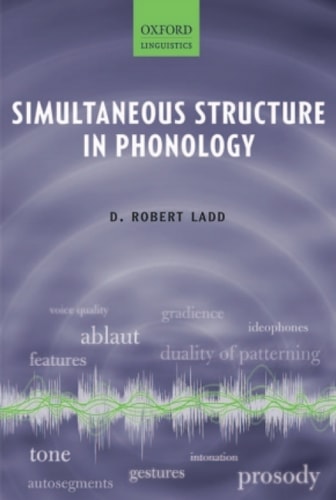
Simultaneous Structure in Phonology
0
0
As an Amazon Associate and affiliate partner, Menrva Books earns from qualifying purchases. Learn more
Author Description
In this book, D. Robert Ladd focuses on problems with the one-dimensional idealization of language on which much linguistic theory is based. Strings of sequentially-ordered elements play an important role as theoretical abstractions in both phonology and syntax. Yet many well-known phonological phenomena (such as vowel harmony, ablaut morphology, and pitch features) are problematic for this one-dimensional idealization, and many attempts (such as autosegmental phonology) have been made to allow for these troublesome characteristics in our theories. The book deals with diverse aspects of these problematical non-sequential phenomena. The five main chapters cover distinctive features and autosegments, systematic phonetics, the definition of 'prosody', aspects of vocal paralinguistic communication and 'gradience', and duality of patterning. Each chapter reviews a wide range of relevant literature, generally going back to the beginnings of modern linguistics in the early twentieth century, and all of them can usefully be read as free-standing synthetic overviews of the issues they discuss. The final chapter suggests that phonological structure, sequential or otherwise, can be seen as a special case of the segmentation of continuous action into discrete events, and that research on this general topic within cognitive psychology is relevant to phonological theory. Professor Ladd's unique work makes a fundamental contribution to phonology and phonetics and to linguistic theory more generally. His book will interest all theoretical linguists and cognitive scientists concerned with understanding the relation between phonological representations and the speech signal.
Menrva's Summary
THE THESIS
This book investigates the limitations of the one-dimensional, sequential model of language that dominates traditional linguistic theory. D. Robert Ladd, a prominent scholar in phonology, examines how non-sequential phenomena—such as vowel harmony, pitch features, and ablaut—challenge standard theoretical frameworks. By synthesizing historical linguistic literature and contemporary research, the author argues that phonological structure should be viewed through a broader lens that accounts for the segmentation of continuous action into discrete events.
THE SCOPE MAP
What You Will Find
- Analysis of autosegmental phonology and distinctive features
- Examination of systematic phonetics and the definition of prosody
- Discussion of vocal paralinguistic communication and gradience
- Integration of cognitive psychology research regarding event segmentation
Scope Limits
- The text focuses primarily on theoretical phonology rather than applied clinical speech pathology
- It does not provide a comprehensive manual for language acquisition or pedagogical instruction
THE AUTHORITY PERSPECTIVE
Experts recognize this work as a significant contribution to the evolution of phonological theory and its intersection with cognitive science. Readers frequently note the academic density of the prose, which serves as a rigorous synthetic overview for advanced students and professional linguists.
Page Count:
208
Publication Date:
2014-01-01
Publisher:
OUP Oxford
ISBN-10:
0191650137
ISBN-13:
9780191650130
Academic
Linguistics
English & College Success
English
Phonetics
Phonology
Community Tags
Similar Books