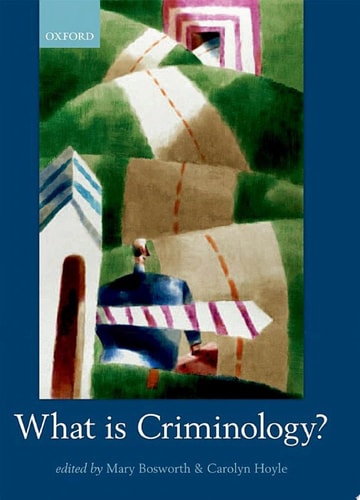
What is Criminology?
0
0
As an Amazon Associate and affiliate partner, Menrva Books earns from qualifying purchases. Learn more
Author Description
Criminology is a booming discipline, yet one which can appear divided and fractious. In this rich and diverse collection of 34 essays, some of the worlds leading criminologists respond to a series of questions designed to investigate the state, impact and future challenges of the discipline: What is criminology for? What is the impact of criminology? How should criminology be done? What are the key issues and debates in criminology today? What challenges does the discipline of criminology face? How has criminology as a discipline changed over the last few decades? The resulting essays identify a series of intellectual, methodological and ideological borders. Borders, in criminology as elsewhere, are policed, yet they are also frequently transgressed; criminologists can and do move across them to plunder, admire, or learn from other regions. While some boundaries may be more difficult or dangerous to cross than others it is rare to find an entirely secluded locale or community. In traversing ideological, political, geographical and disciplinary borders, criminologists bring training, tools and concepts, as well as key texts to share with foreigners. From such exchanges, over time, borders may break down, shift, or spring up, enriching those who take the journey and those who are visited. It is, in other words, in criminologys capacity for and commitment to reflexivity, on which the strength of the field depends.
Menrva's Summary
THE THESIS
This collection investigates the current state, disciplinary boundaries, and future trajectory of criminology as a field of study. Editors Mary Bosworth and Carolyn Hoyle curate 34 essays from prominent global scholars to address foundational questions regarding the purpose, methodology, and impact of criminological research. The text argues that the strength of the discipline relies on its capacity for reflexivity and its willingness to traverse ideological and methodological borders.
THE SCOPE MAP
What You Will Find
- A collection of 34 essays from leading international criminologists.
- Analysis of the evolution of criminological research over several decades.
- Discussions on the intersection of criminology with other social science disciplines.
Scope Limits
- The text does not serve as a comprehensive introductory textbook for undergraduate students.
- It does not provide a singular, unified definition of criminology, but rather highlights the fractious nature of the field.
THE AUTHORITY PERSPECTIVE
Experts recognize this work as a significant contribution to the meta-analysis of the discipline, providing a snapshot of contemporary academic debates. Scholars frequently cite the collection for its focus on the intellectual borders that define and limit criminological inquiry.
Page Count:
588
Publication Date:
2012-01-01
Publisher:
OUP Oxford
ISBN-10:
0191635413
ISBN-13:
9780191635410
Criminology
Social Science
Law
Academic
Professional Career & Trade
Sociology
Community Tags
Similar Books