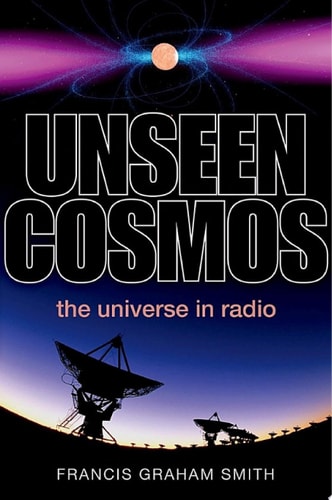
Unseen Cosmos: The Universe in Radio
0
0
As an Amazon Associate and affiliate partner, Menrva Books earns from qualifying purchases. Learn more
Author Description
Radio telescopes have transformed our understanding of the Universe. Pulsars, quasars, Big Bang cosmology: all are discoveries of the new science of radio astronomy. Here, Francis Graham-Smith describes the birth, development, and maturity of radio astronomy, from the first discovery of cosmic radio waves to its present role as a major part of modern astronomy. Radio is part of the electromagnetic spectrum, covering infra-red, visible light, ultraviolet, X-rays, and gamma-rays, and Graham-Smith explains why it is that radio waves give us a unique view of the Universe. Tracing the development of radio telescopes he shows how each new idea in observing techniques has led to new discoveries, and looks at the ways in which radio waves are generated in the various cosmic sources, relating this to the radio world of mobile phones, radio and television channels, wireless computer connections, and remote car locks. Today a new generation of radio telescopes promises to extend our understanding of the Universe into further, as yet unknown, fields. Huge new radio telescopes are being built, such as the Atacama Large Millimetre Array (ALMA), Low Frequency Array for Radioastronomy (LOFAR), and the Square Kilometre Array (SKA). Radio telescopes on spacecraft such as the Cosmic Microwave Explorer (COBE) and Planck are tracing in minute detail the faint but universal radio signal from the expanding early Universe. Graham-Smith shares the excitement of discovering the wonders of the radio universe, and the possibilities promised by the new age of giant radio telescopes.
Menrva's Summary
THE THESIS
This book investigates the evolution of radio astronomy and its critical role in expanding human understanding of the electromagnetic spectrum and the origins of the universe. Francis Graham-Smith, a distinguished astronomer, utilizes his extensive background in the field to document the transition of radio astronomy from its nascent stages to its current status as a cornerstone of modern astrophysics. He presents a framework that links the technical development of radio telescopes with the fundamental physical processes that generate cosmic radio waves.
THE SCOPE MAP
What You Will Find
- Historical development of radio astronomy from initial cosmic wave detection to modern arrays.
- Technical explanations of electromagnetic spectrum properties and radio wave generation.
- Overviews of major projects including ALMA, LOFAR, and the Square Kilometre Array.
- Comparisons between cosmic radio sources and terrestrial wireless technologies.
Scope Limits
- The text does not provide advanced mathematical derivations for astrophysical phenomena.
- It does not focus on the engineering specifications of individual telescope components.
THE AUTHORITY PERSPECTIVE
Experts recognize this work as a clear and accessible introduction to the field of radio astronomy for non-specialists. Readers frequently note that the prose balances technical history with conceptual clarity, making it a standard reference for those interested in the evolution of modern observational tools.
Page Count:
246
Publication Date:
2013-01-01
Publisher:
OUP Oxford
ISBN-10:
0191636258
ISBN-13:
9780191636257
Science
Astronomy
Astrophysics
Earth Sciences
Physics
Introductory Astronomy
Cosmology
Community Tags
Similar Books