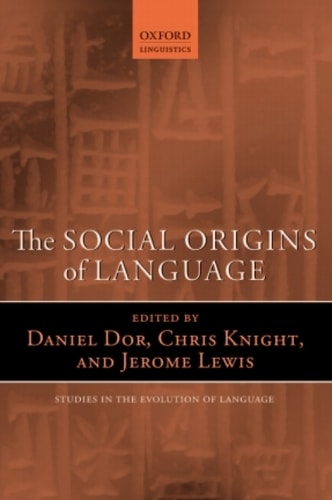
The Social Origins of Language
0
0
As an Amazon Associate and affiliate partner, Menrva Books earns from qualifying purchases. Learn more
Author Description
This book offers an exciting new perspective on the origins of language. Language is conceptualized as a collective invention, on the model of writing or the wheel, and the book places social and cultural dynamics at the centre of its evolution: language emerged and further developed in human communities already suffused with meaning and communication, mimesis, ritual, song and dance, alloparenting, new divisions of labour and revolutionary changes in social relations. The book thus challenges assumptions about the causal relations between genes, capacities, social communication and innovation: the biological capacities are taken to evolve incrementally on the basis of cognitive plasticity, in a process that recruits previous adaptations and fine-tunes them to serve novel communicative ends. Topics include the ability brought about by language to tell lies, that must have confronted our ancestors with new problems of public trust; the dynamics of social-cognitive co-evolution; the role of gesture and mimesis in linguistic communication; studies of how monkeys and apes express their feelings or thoughts; play, laughter, dance, song, ritual and other social displays among extant hunter-gatherers; the social nature of language acquisition and innovation; normativity and the emergence of linguistic norms; the interaction of language and emotions; and novel perspectives on the time-frame for language evolution. The contributors are leading international scholars from linguistics, anthropology, palaeontology, primatology, psychology, evolutionary biology, artificial intelligence, archaeology, and cognitive science.
Menrva's Summary
THE THESIS
This volume investigates the core question of how language emerged as a collective social invention rather than a purely biological adaptation. Daniel Dor and a multidisciplinary team of international scholars argue that language evolved within human communities already rich in ritual, mimesis, and social complexity. The text posits that biological capacities evolved incrementally through cognitive plasticity, fine-tuning existing adaptations to meet new communicative requirements within a social framework.
THE SCOPE MAP
What You Will Find
- Analysis of the co-evolution of social cognition and linguistic communication
- Examination of non-verbal precursors such as gesture, dance, song, and ritual
- Discussion of the emergence of normativity and the challenges of public trust
- Comparative studies of primate communication and social displays in hunter-gatherer societies
Scope Limits
- The text does not provide a definitive timeline for the exact origin of speech
- It avoids purely nativist or genetic-deterministic explanations of linguistic development
THE AUTHORITY PERSPECTIVE
Experts recognize this work as a significant contribution to the interdisciplinary study of language evolution, particularly for its focus on social dynamics over biological reductionism. Readers frequently note the academic density of the prose, which requires a foundational understanding of linguistics and evolutionary theory to fully synthesize the arguments presented.
Page Count:
528
Publication Date:
2014-01-01
Publisher:
OUP Oxford
ISBN-10:
0191643122
ISBN-13:
9780191643125
Linguistics
Anthropology
Evolutionary Biology
Social Science
English
English & College Success
Community Tags
Similar Books