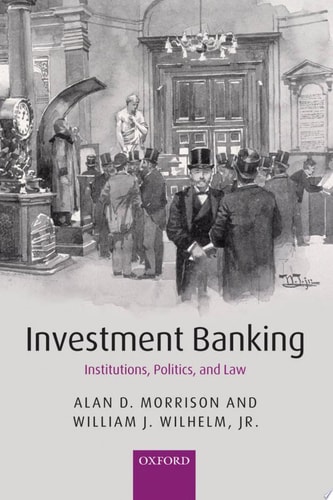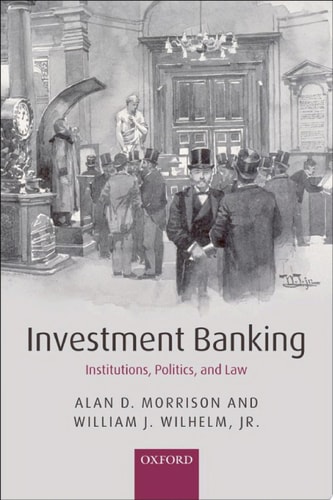
Investment Banking: Institutions, Politics, and Law
0
0
As an Amazon Associate and affiliate partner, Menrva Books earns from qualifying purchases. Learn more
Author Description
Investment Banking: Institutions, Politics, and Law provides an economic rationale for the dominant role of investment banks in the capital markets, and uses it to explain both the historical evolution of the investment banking industry and also recent changes to its organization. Although investment decisions rely upon price-relevant information, it is impossible to establish property rights over it and hence is very hard to coordinate its exchange. The authors argue that investment banks help to resolve this problem by managing "information marketplaces," within which extra-legal institutions support the production and dissemination of information that is important to investors. Reputations and relationships are more important in fulfilling this role than financial capital. The authors substantiate their theory with reference to the industry's evolution during the last three centuries. They show how investment banking networks were formed, and identify the informal contracts that they supported. This historical development points to tensions between the relational contracting of investment banks and the regulatory impulses of the State, thus providing some explanation for the periodic large-scale State intervention in the operation of capital markets. Their theory also provides a technological explanation for the massive restructuring of the capital markets in recent decades, which the authors argue can be used to think about the likely future direction of the investment banking industry.
Menrva's Summary
THE THESIS
This book investigates the economic rationale behind the dominance of investment banks in capital markets and how their role has evolved through history. The authors, Alan D. Morrison and William J. Wilhelm, utilize a framework centered on the management of information marketplaces to explain industry organization. They argue that investment banks function primarily by facilitating the exchange of information that is otherwise difficult to coordinate due to the impossibility of establishing property rights over it. By analyzing three centuries of industry development, the authors demonstrate how relational contracting and reputation-based networks have historically navigated tensions with state regulatory impulses.
THE SCOPE MAP
What You Will Find
- A theoretical framework for understanding investment banking as an information marketplace manager.
- Historical analysis of investment banking networks over the last three hundred years.
- Examination of the conflict between informal relational contracts and state regulatory interventions.
- Technological explanations for the restructuring of capital markets in recent decades.
Scope Limits
- The text does not provide a practical manual for day-to-day investment banking operations or financial modeling.
- It does not offer specific investment advice or predictive market analysis for individual retail investors.
THE AUTHORITY PERSPECTIVE
Experts frequently cite this work as a foundational text for understanding the institutional and political underpinnings of the financial sector. Readers often note the academic density of the prose, which is best suited for students and professionals interested in the intersection of law, economics, and financial history.
Page Count:
362
Publication Date:
2008-01-01
Publisher:
OUP Oxford
ISBN-10:
0191647845
ISBN-13:
9780191647840
Economics
Business History
Law and Economics
Finance
Community Tags
Similar Books