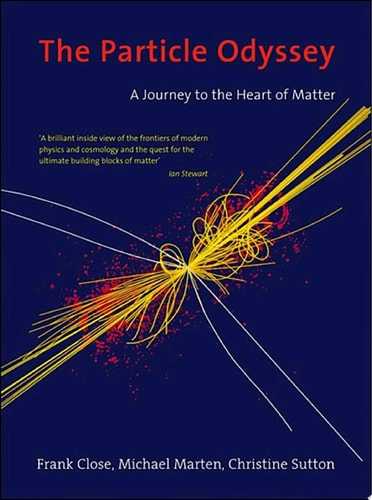
The Particle Odyssey: A Journey to the Heart of Matter
0
0
As an Amazon Associate and affiliate partner, Menrva Books earns from qualifying purchases. Learn more
Author Description
During the 20th century, scientists discovered what the Universe is made of; as the 21st century begins, they are preparing experiments to find out how it came to be like this. This great adventure, which will involve a metaphorical journey back in time to within a billionth of a second of the Big Bang, is the latest stage in the quest to understand the nature of the matter that makes our Universe and the forces that govern it. The Particle Odyssey takes the reader on a spectacularly illustrated journey to the heart of matter. In clear, non-technical language the authors describe the key experiments and fundamental discoveries which have led to our current understanding of the origins and nature of the material universe. In this fascinating book, you will find individual 'portraits' of all the major subatomic particles, from the electron to the top quark. The authors describe the history of experimental particle physics: its origins in the discovery of X-rays in 1895; the dissection of the atom by Rutherford and others; the unexpected revelations of the cosmic rays; the explosion of new particles in the 1950s and 60s; the discovery of quarks and the rise of the 'standard model' in the last part of the 20th century. And they also look at the great challenges that face physicists today—where did antimatter go? what is dark matter? can there be a theory of everything?—and the experiments they are devising to explore them. The Particle Odyssey brings together and presents with style over 100 of the best images of particle 'events': mysterious, abstract, beautiful pictures of the tracks of subatomic particles as they speed, curve, dance, or explode through cloud and bubble chambers, stacks of photographic emulsion, and the giant multi-element detectors of modern experiments. Here are spiralling electrons, the tell-tale 'vees' of strange particles, matter and antimatter born from raw energy, energetic jets of particles spraying out from the decay points of quarks and gluo
Menrva's Summary
THE THESIS
This work investigates the fundamental composition of the universe and the experimental history that has defined our current understanding of subatomic particles. The authors, including physicist Frank Close, synthesize decades of particle physics research to explain how scientists have mapped the building blocks of matter from the discovery of X-rays to the development of the Standard Model. By pairing historical narrative with visual evidence, the text argues that the evolution of experimental detection methods is inseparable from our conceptual grasp of the physical laws governing the cosmos.
THE SCOPE MAP
What You Will Find
- A chronological history of particle physics from 1895 to the early 21st century.
- Detailed profiles of subatomic particles, including electrons, quarks, and cosmic rays.
- A collection of over 100 visual records of particle interactions captured in cloud and bubble chambers.
- Discussions on contemporary challenges such as dark matter, antimatter, and the search for a unified theory.
Scope Limits
- The text avoids highly technical mathematical proofs, focusing instead on conceptual and historical explanations.
- It does not provide an exhaustive technical manual for modern particle accelerator operation.
THE AUTHORITY PERSPECTIVE
Experts and readers frequently commend this book for its ability to make complex particle physics accessible through its extensive use of visual data. It is widely regarded as a foundational text for those seeking to understand the history and experimental methodology of subatomic research without requiring an advanced physics background.
Page Count:
260
Publication Date:
2004-01-01
Publisher:
OUP Oxford
ISBN-10:
0191647446
ISBN-13:
9780191647444
Science
Non-Fiction
history music
Particle Physics
Physics
Nuclear Physics
Music Technology
Science History
Community Tags
Similar Books

Reader Comments
Share Your Thoughts
No comments yet. Be the first to share your thoughts!