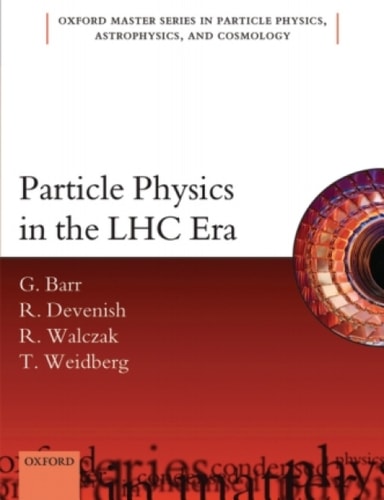
Particle Physics in the LHC Era
0
0
As an Amazon Associate and affiliate partner, Menrva Books earns from qualifying purchases. Learn more
Author Description
This is an open access title. It is available to read and download as a free PDF version on Oxford Academic and is made available under a Creative Commons Attribution 4.0 licence. This text gives an introduction to particle physics at a level accessible to advanced undergraduate students. It is based on lectures given to 4th year physics students over a number of years, and reflects the feedback from the students. The aim is to explain the theoretical and experimental basis of the Standard Model (SM) of Particle Physics with the simplest mathematical treatment possible. All the experimental discoveries that led to the understanding of the SM relied on particle detectors and most of them required advanced particle accelerators. A unique feature of this book is that it gives a serious introduction to the fundamental accelerator and detector physics, which is currently only available in advanced graduate textbooks. The mathematical tools that are required such as group theory are covered in one chapter. A modern treatment of the Dirac equation is given in which the free particle Dirac equation is seen as being equivalent to the Lorentz transformation. The idea of generating the SM interactions from fundamental gauge symmetries is explained. The core of the book covers the SM. The tools developed are used to explain its theoretical basis and a clear discussion is given of the critical experimental evidence which underpins it. A thorough account is given of quark flavour and neutrino oscillations based on published experimental results, including some from running experiments. A simple introduction to the Higgs sector of the SM is given. This explains the key idea of how spontaneous symmetry breaking can generate particle masses without violating the underlying gauge symmetry. A key feature of this book is that it gives an accessible explanation of the discovery of the Higgs boson, including the advanced statistical techniques required. The final chapter gives an introdu
Menrva's Summary
THE THESIS
This text investigates the theoretical and experimental foundations of the Standard Model of particle physics within the context of the Large Hadron Collider era. The authors, all experienced physics educators, synthesize years of lecture material into a structured curriculum designed for advanced undergraduate students. By prioritizing conceptual clarity and minimizing complex mathematical formalism, the book provides a bridge between introductory physics and graduate-level research.
THE SCOPE MAP
What You Will Find
- Theoretical framework of the Standard Model and gauge symmetries
- Fundamental principles of particle accelerators and detector physics
- Analysis of quark flavor, neutrino oscillations, and the Higgs sector
- Statistical methodologies used in modern particle discovery
Scope Limits
- Does not provide an exhaustive treatment of advanced quantum field theory
- Excludes speculative physics beyond the Standard Model
THE AUTHORITY PERSPECTIVE
Experts and educators recognize this text as a highly effective pedagogical tool for bridging the gap between undergraduate coursework and professional research. Readers frequently note the clarity of the explanations regarding detector physics, which is often omitted in other introductory-level physics textbooks.
Page Count:
432
Publication Date:
2016-01-01
Publisher:
OUP Oxford
ISBN-10:
0191065455
ISBN-13:
9780191065453
Science
Physics
Earth Sciences
Nuclear Physics
Academic
Particle Physics
textbook
Community Tags
Other Editions(3)
Similar Books




Reader Comments
Share Your Thoughts
No comments yet. Be the first to share your thoughts!