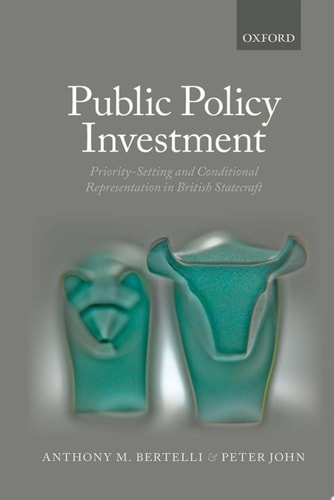
Public Policy Investment: Priority-Setting and Conditional Representation In British Statecraft
0
0
As an Amazon Associate and affiliate partner, Menrva Books earns from qualifying purchases. Learn more
Author Description
This book addresses one of the enduring questions of democratic government: why do governments choose some public policies but not others? Political executives focus on a range of policy issues, such as the economy, social policy, and foreign policy, but they shift their priorities over time. Despite an extensive literature, it has proven surprisingly hard to explain policy prioritisation. To remedy this gap, this book offers a new approach called public policy investment: governments enhance their chances of getting re-elected by managing a portfolio of public policies and paying attention to the risks involved. In this way, government is like an investor making choices about risk to yield returns on its investments of political capital. The public provides signals about expected political capital returns for government policies, or policy assets, that can be captured through expressed opinion in public polls. Governments can anticipate these signals in the choices they make. Statecraft is the ability political leaders have to consider risk and return in their policy portfolios and do so amidst uncertainty in the public's policy valuation. Such actions represent the public's views conditionally because not every opinion change is a price signal. It then outlines a quantitative method for measuring risk and return, applying it to the case of Britain between 1971 and 2000 and offers case studies illustrating statecraft by prime ministers, such as Edward Heath or Margaret Thatcher. The book challenges comparative scholars to apply public policy investment to countries that have separation of powers, multiparty government, and decentralization.
Menrva's Summary
THE THESIS
This book investigates the mechanisms governing how political executives prioritize specific public policies over others within a democratic framework. Authors Anthony Bertelli and Peter John, both established scholars in political science and public administration, propose a novel framework termed 'public policy investment.' They argue that governments function similarly to financial investors, managing a portfolio of policy assets to maximize political capital while mitigating risks associated with public opinion and electoral outcomes.
THE SCOPE MAP
What You Will Find
- A theoretical model of 'public policy investment' based on risk and return analysis.
- Quantitative methodologies for measuring policy risk and political capital returns.
- Historical analysis of British statecraft from 1971 to 2000.
- Case studies focusing on the administrations of Edward Heath and Margaret Thatcher.
Scope Limits
- The primary analysis is restricted to the British parliamentary system.
- The framework does not explicitly detail applications for systems with separation of powers or decentralized governance.
THE AUTHORITY PERSPECTIVE
Scholars in the field of comparative politics and public policy view this work as a rigorous attempt to formalize the study of executive priority-setting. Readers frequently note the academic density of the prose and the specialized nature of the quantitative methods employed throughout the text.
Page Count:
224
Publication Date:
2013-01-01
Publisher:
OUP Oxford
ISBN-10:
0191640603
ISBN-13:
9780191640605
Public Policy
British Politics
Comparative Politics
Government
Community Tags
Similar Books