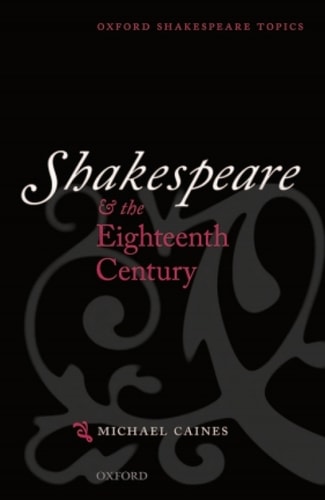
Shakespeare and the Eighteenth Century
0
0
As an Amazon Associate and affiliate partner, Menrva Books earns from qualifying purchases. Learn more
Author Description
OXFORD SHAKESPEARE TOPICS General Editors: Peter Holland and Stanley Wells Oxford Shakespeare Topics provide students and teachers with short books on important aspects of Shakespeare criticism and scholarship. Each book is written by an authority in its field, and combines accessible style with original discussion of its subject. This book considers the impact and influence of Shakespeare on writing of the eighteenth century, and also how eighteenth-century Shakespeare scholarship influenced how we read Shakespeare today. The most influential English actor of the eighteenth century, David Garrick, could hail Shakespeare as 'the god of our idolatry', yet perform an adaptation of King Lear with a happy ending, add a dying speech to Macbeth, and remove the puns from Romeo and Juliet. Garrick's friend Samuel Johnson thought of Shakespeare as 'above all writers, at least above all modern writers, the poet of nature'. Voltaire thought he was a sublime genius without taste. The Bluestocking Elizabeth Montagu, meanwhile, could be found arguing with Johnson's biographer James Boswell over whether Shakespeare or Milton was the greater poet. Shakespeare and the Eighteenth Century traces the course of a many-faceted metamorphosis. Drawing on fresh research as well as the most recent scholarship in the field, it argues that the story of Shakespeare in the eighteenth century has become a significant 'subplot' in later scholarship, made up of great debates about how to read Shakespeare and how to rank him among the great English writers, how to perform his plays and how to edit the texts of those plays. This book surveys the critical and creative responses of actors and audiences, literary critics and textual editors, painters and philosophes to Shakespeare's works, while also suggesting how the Shakespeare of the theatre influenced the Shakespeare of the study, and how other, less straightforward interactions combined to bring about this sea-change in English cultural life.
Menrva's Summary
THE THESIS
This book investigates the complex evolution of Shakespeare's reputation and influence during the eighteenth century, examining how the era's critical, theatrical, and editorial practices fundamentally shaped modern perceptions of the playwright. Michael M. Caines, a scholar in the field, utilizes historical records, contemporary criticism, and theatrical history to argue that the eighteenth century served as a critical turning point in the canonization of Shakespeare. The text explores the tension between the era's reverence for the 'poet of nature' and its tendency to heavily adapt, edit, and rewrite his works for contemporary tastes.
THE SCOPE MAP
What You Will Find
- Analysis of eighteenth-century Shakespearean adaptations, including those by David Garrick.
- Examination of critical debates involving figures such as Samuel Johnson, Voltaire, and Elizabeth Montagu.
- Discussion of the development of textual editing and the professionalization of Shakespearean scholarship.
- Exploration of the interplay between theatrical performance and literary study.
Scope Limits
- The text focuses primarily on the eighteenth-century reception and adaptation rather than a comprehensive biography of Shakespeare himself.
- It does not provide an exhaustive catalog of every eighteenth-century production, focusing instead on influential trends and debates.
THE AUTHORITY PERSPECTIVE
Scholars and students frequently cite this work as a concise and accessible entry point into the history of Shakespearean reception. Experts highlight the book's ability to synthesize complex critical debates into a clear narrative for those studying the intersection of theater history and literary criticism.
Page Count:
232
Publication Date:
2013-01-01
Publisher:
OUP Oxford
ISBN-10:
0191642932
ISBN-13:
9780191642937
Theater History
Literary Criticism
English
English & College Success
Academic
Eighteenth Century
Community Tags
Similar Books