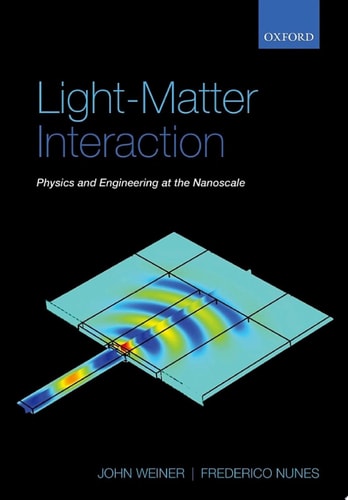
Light-Matter Interaction
0
0
As an Amazon Associate and affiliate partner, Menrva Books earns from qualifying purchases. Learn more
Author Description
This Book Draws Together The Essential Elements Of Classical Electrodynamics, Surface Wave Physics, Plasmonic Materials, And Circuit Theory Of Electrical Engineering To Provide Insight Into The Essential Physics Of Nanoscale Light-matter Interaction And To Provide Design Methodology For Practical Nanoscale Plasmonic Devices. A Chapter On Classical And Quantal Radiation Also Highlights The Similarities (and Differences) Between The Classical Fields Of Maxwell's Equations And The Wave Functions Of Schrödinger's Equation. The Aim Of This Chapter Is To Provide A Semiclassical Picture Of Atomic Absorption And Emission Of Radiation, Lending Credence And Physical Plausibility To The Rules Of Standard Wave-mechanical Calculations. The Structure Of The Book Is Designed Around Five Principal Chapters, But Many Of The Chapters Have Extensive Complements That Either Treat Important Digressions From The Main Body Or Penetrate Deeper Into Some Fundamental Issue. Furthermore, At The End Of The Book Are Several Appendices To Provide Readers With A Convenient Reference For Frequently-occurring Special Functions And Explanations Of The Analytical Tools, Such As Vector Calculus And Phasors, Needed To Express Important Results In Electromagnetics And Waveguide Theory.
Menrva's Summary
THE THESIS
This book investigates the fundamental physical principles governing light-matter interaction at the nanoscale and establishes a design methodology for practical plasmonic devices. The authors, Frederico Nunes and John Weiner, synthesize concepts from classical electrodynamics, surface wave physics, and circuit theory to bridge the gap between theoretical physics and engineering applications. By integrating Maxwell's equations with Schrödinger's wave functions, the text provides a semiclassical framework for understanding atomic radiation processes.
THE SCOPE MAP
What You Will Find
- Analysis of classical electrodynamics and surface wave physics
- Theoretical framework for plasmonic materials and circuit theory
- Semiclassical treatment of atomic absorption and emission
- Mathematical appendices covering vector calculus and phasors
Scope Limits
- Does not provide an exhaustive survey of quantum electrodynamics
- Focuses primarily on nanoscale applications rather than macro-scale optics
THE AUTHORITY PERSPECTIVE
Experts identify this text as a rigorous resource for students and researchers working at the intersection of electrical engineering and nanophotonics. Readers frequently note the technical density of the prose, which requires a strong background in electromagnetics and wave mechanics to fully utilize the provided design methodologies.
Page Count:
280
Publication Date:
2012-01-01
Publisher:
Oup Oxford
ISBN-10:
0191650099
ISBN-13:
9780191650093
Physics
Nanotechnology
Optics
Engineering
Community Tags
Similar Books