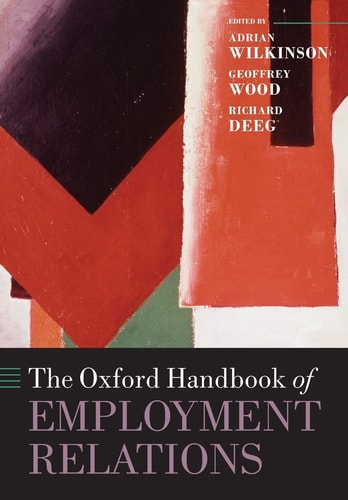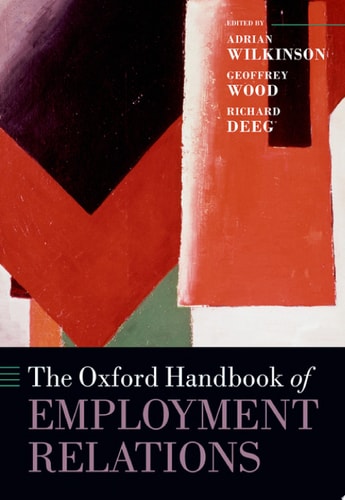
The Oxford Handbook of Employment Relations
0
0
As an Amazon Associate and affiliate partner, Menrva Books earns from qualifying purchases. Learn more
Author Description
There Have Been Numerous Accounts Exploring The Relationship Between Institutions And Firm Practices. However, Much Of This Literature Tends To Be Located Into Distinct Theoretical-traditional 'silos', Such As National Business Systems, Social Systems Of Production, Regulation Theory, Or Varieties Of Capitalism, With Limited Dialogue Between Different Approaches To Enhance Understanding Of Institutional Effects. Again, Evaluations Of The Relationship Between Institutions And Employment Relations Have Tended To Be Of The Broad-brushstroke Nature, Often Founded On Macro-data, And With Only Limited Attention Being Accorded To Internal Diversity And Details Of Actual Practice. The Handbook Aims To Fill This Gap By Bringing Together An Assembly Of Comprehensive And High Quality Chapters To Enable Understanding Of Changes In Employment Relations Since The Early 1970s. Theoretically-based Chapters Attempt To Link Varieties Of Capitalism, Business Systems, And Different Modes Of Regulation To The Specific Practice Of Employment Relations, And Offer A Truly Comparative Treatment Of The Subject, Providing Frameworks And Empirical Evidence For Understanding Trends In Employment Relations In Different Parts Of The World. Most Notably, The Handbook Seeks To Incorporate At A Theoretical Level Regulationist Accounts And Recent Work That Link Bounded Internal Systemic Diversity With Change, And, At An Applied Level, A Greater Emphasis On Recent Applied Evidence, Specifically Dealing With The Employment Contract, Its Implementation, And Related Questions Of Work Organization. It Will Be Useful To Academics And Students Of Industrial Relations, Political Economy, And Management.
Menrva's Summary
THE THESIS
This volume investigates the complex interplay between institutional frameworks and firm-level employment practices, addressing the historical disconnect between theoretical silos in the field of industrial relations. The editors, Adrian Wilkinson, Richard Deeg, and Geoffrey Wood, synthesize diverse perspectives—including Varieties of Capitalism and regulation theory—to provide a comprehensive analysis of how institutional structures influence labor practices. By bridging macro-level systemic analysis with micro-level organizational reality, the text offers a framework for understanding the evolution of employment relations since the 1970s.
THE SCOPE MAP
What You Will Find
- Comparative analysis of national business systems and social systems of production
- Theoretical integration of regulationist accounts with internal systemic diversity
- Empirical evidence regarding the employment contract and work organization
- Global trends in employment relations across different economic models
Scope Limits
- Does not provide a singular, unified theory of employment relations
- Focuses primarily on institutional and systemic factors rather than individual psychological or behavioral aspects of labor
THE AUTHORITY PERSPECTIVE
Experts identify this handbook as a foundational reference for scholars and students navigating the intersection of political economy and industrial relations. Readers frequently note the academic density of the prose, which serves as a rigorous resource for those seeking to understand the institutional drivers of contemporary workplace change.
Page Count:
760
Publication Date:
2014-01-01
Publisher:
Oup Oxford
ISBN-10:
0191651486
ISBN-13:
9780191651489
Business
Economics
Industrial Relations
Employment Relations
Management
Community Tags
Similar Books