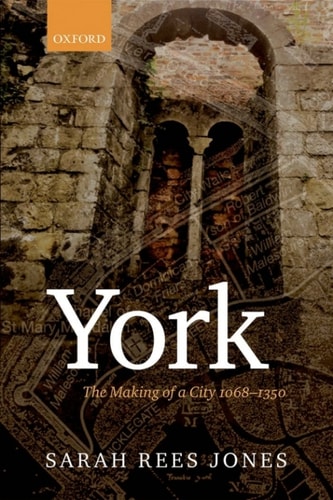
York: The Making of a City 1068-1350
0
0
As an Amazon Associate and affiliate partner, Menrva Books earns from qualifying purchases. Learn more
Author Description
York was one of the most important cities in medieval England. This original study traces the development of the city from the Norman Conquest to the Black Death. The twelfth and thirteenth centuries are a neglected period in the history of English towns, and this study argues that the period was absolutely fundamental to the development of urban society and that up to now we have misunderstood the reasons for the development of York and its significance within our history because of that neglect. Medieval York argues that the first Norman kings attempted to turn the city into a true northern capital of their new kingdom and had a much more significant impact on the development of the city than has previously been realised. Nevertheless the influence of York Minster, within whose shadow the town had originally developed, remained strong and was instrumental in the emergence of a strong and literate civic communal government in the later twelfth and thirteenth centuries. Many of the earlier Norman initiatives withered as the citizens developed their own institutions of government and social welfare. The primary sources used are records of property ownership and administration, especially charters, and combines these with archaeological evidence from the last thirty years. Much of the emphasis of the book is therefore on the topographical development of the city and the changing social and economic structures associated with property ownership and occupation.
Menrva's Summary
THE THESIS
This study investigates how the city of York evolved from the Norman Conquest through the Black Death, challenging the notion that the twelfth and thirteenth centuries were a period of urban stagnation. Sarah Rees Jones, a specialist in medieval urban history, utilizes a synthesis of administrative records and modern archaeological data to argue that the Norman influence was more foundational to York's development as a northern capital than previously acknowledged. The work posits that the interplay between the ecclesiastical power of York Minster and the emerging civic government was the primary driver of the city's social and economic structure.
THE SCOPE MAP
What You Will Find
- Analysis of property ownership records and charters from 1068 to 1350
- Integration of archaeological findings from the late twentieth century
- Examination of the topographical evolution of urban spaces
- Study of the transition from Norman-imposed structures to independent civic governance
Scope Limits
- Does not provide a comprehensive political history of the broader northern region
- Focuses primarily on institutional and physical development rather than personal biographies of citizens
THE AUTHORITY PERSPECTIVE
Historians and urban scholars frequently cite this work as a critical re-evaluation of medieval town development in England. Readers note the high density of the prose and the rigorous reliance on primary source documentation to support the author's arguments.
Page Count:
416
Publication Date:
2013-01-01
Publisher:
OUP Oxford
ISBN-10:
0191651575
ISBN-13:
9780191651571
History
Archaeology
British History
European History
Urban History
Community Tags
Similar Books