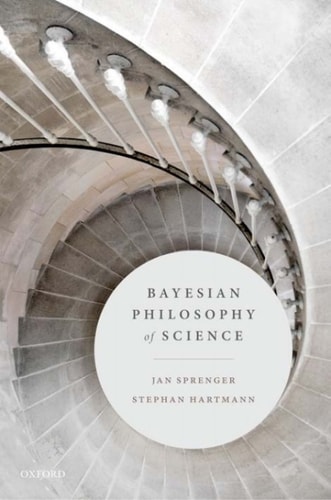
Bayesian Philosophy of Science
0
0
As an Amazon Associate and affiliate partner, Menrva Books earns from qualifying purchases. Learn more
Author Description
How should we reason in science? Jan Sprenger and Stephan Hartmann offer a refreshing take on classical topics in philosophy of science, using a single key concept to explain and to elucidate manifold aspects of scientific reasoning. They present good arguments and good inferences as being characterized by their effect on our rational degrees of belief. Refuting the view that there is no place for subjective attitudes in 'objective science', Sprenger and Hartmann explain the value of convincing evidence in terms of a cycle of variations on the theme of representing rational degrees of belief by means of subjective probabilities (and changing them by Bayesian conditionalization). In doing so, they integrate Bayesian inference--the leading theory of rationality in social science--with the practice of 21st century science. Bayesian Philosophy of Science thereby shows how modeling such attitudes improves our understanding of causes, explanations, confirming evidence, and scientific models in general. It combines a scientifically minded and mathematically sophisticated approach with conceptual analysis and attention to methodological problems of modern science, especially in statistical inference, and is therefore a valuable resource for philosophers and scientific practitioners.
Menrva's Summary
THE THESIS
This book investigates how Bayesian probability theory provides a unified framework for understanding scientific reasoning and objective inference. Authors Jan Sprenger and Stephan Hartmann, both established scholars in the philosophy of science, argue that scientific rationality is best modeled through the lens of subjective probabilities and Bayesian conditionalization. By bridging the gap between formal statistical methods and traditional philosophical inquiry, they demonstrate how these tools clarify complex issues regarding evidence, causality, and model selection in modern research.
THE SCOPE MAP
What You Will Find
- A comprehensive application of Bayesian conditionalization to scientific practice.
- Analysis of how subjective degrees of belief interact with objective scientific evidence.
- Frameworks for evaluating causal inference, explanation, and model validation.
Scope Limits
- The text assumes a baseline familiarity with formal logic and statistical concepts.
- It does not provide a historical survey of non-Bayesian philosophies of science.
THE AUTHORITY PERSPECTIVE
Experts recognize this work as a significant synthesis of formal epistemology and contemporary scientific practice. Readers frequently note the technical density of the prose, which serves as a rigorous resource for both philosophers and practicing scientists.
Page Count:
416
Publication Date:
2019-01-01
Publisher:
OUP Oxford
ISBN-10:
0191652229
ISBN-13:
9780191652226
Philosophy
Science
Bayesian Statistics
Logic & Critical Reasoning
Philosophy of
Decision Theory
Logic
Epistemology
Community Tags
Similar Books