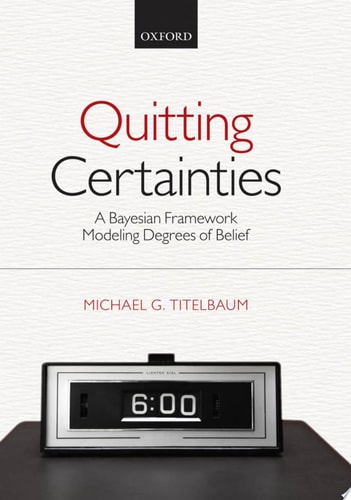
Quitting Certainties: A Bayesian Framework Modeling Degrees of Belief
0
0
As an Amazon Associate and affiliate partner, Menrva Books earns from qualifying purchases. Learn more
Author Description
Michael G. Titelbaum presents a new Bayesian framework for modeling rational degrees of belief, called the Certainty-Loss Framework. Subjective Bayesianism is epistemologists' standard theory of how individuals should change their degrees of belief over time. But despite the theory's power, it is widely recognized to fail for situations agents face every day--cases in which agents forget information, or in which they assign degrees of belief to self-locating claims. Quitting Certainties argues that these failures stem from a common source: the inability of Conditionalization (Bayesianism's traditional updating rule) to model claims' going from certainty at an earlier time to less-than-certainty later on. It then presents a new Bayesian updating framework that accurately represents rational requirements on agents who undergo certainty loss.Titelbaum develops this new framework from the ground up, assuming little technical background on the part of his reader. He interprets Bayesian theories as formal models of rational requirements, leading him to discuss both the elements that go into a formal model and the general principles that link formal systems to norms. By reinterpreting Bayesian methodology and altering the theory's updating rules, Titelbaum is able to respond to a host of challenges to Bayesianism both old and new. These responses lead in turn to deeper questions about commitment, consistency, and the nature of information.Quitting Certainties presents the first systematic, comprehensive Bayesian framework unifying the treatment of memory loss and context-sensitivity. It develops this framework, motivates it, compares it to alternatives, then applies it to cases in epistemology, decision theory, the theory of identity, and the philosophy of quantum mechanics.
Menrva's Summary
THE THESIS
This book investigates the limitations of traditional Bayesian updating rules when agents experience memory loss or encounter self-locating information. Michael G. Titelbaum, a philosopher specializing in formal epistemology, introduces the Certainty-Loss Framework to address these failures. By reinterpreting Bayesian methodology, he develops a systematic model that accounts for how rational agents transition from certainty to uncertainty over time. The text bridges the gap between formal mathematical models and normative requirements for rational belief.
THE SCOPE MAP
What You Will Find
- The Certainty-Loss Framework as an alternative to traditional Conditionalization.
- Analysis of self-locating beliefs and memory loss scenarios.
- Applications of the framework to decision theory and the philosophy of quantum mechanics.
- A foundational discussion on the link between formal systems and rational norms.
THE AUTHORITY PERSPECTIVE
Experts recognize this work as a significant contribution to formal epistemology, particularly for its attempt to unify disparate problems within Bayesian theory. Readers frequently note the technical rigor of the prose, which remains accessible to those with a basic understanding of philosophical logic.
Page Count:
368
Publication Date:
2013-03-01
Publisher:
Oxford University Press
ISBN-10:
0199658307
ISBN-13:
9780199658305
Philosophy
Epistemology
Bayesian Statistics
Logic
Decision Theory
Community Tags
Similar Books