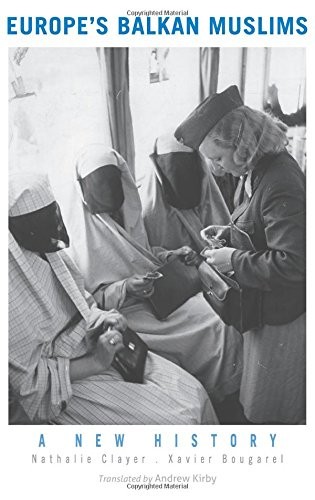
Europe's Balkan Muslims
0
0
As an Amazon Associate and affiliate partner, Menrva Books earns from qualifying purchases. Learn more
Author Description
There are roughly eight million Muslims in south-east Europe, among them Albanians, Bosniaks, Turks and Roma -- descendants of converts or settlers in the Ottoman period. This new history of the social, political and religious transformations that this population experienced in the nineteenth and twentieth centuries -- a period marked by the collapse of the Ottoman, Austro-Hungarian and Russian Empires and by the creation of the modern Balkan states -- will shed new light on the European Muslim experience. Southeast Europe's Muslims have experienced a slow and complex crystallisation of their respective national identities, which accelerated after 1945 as a result of the authoritarian modernisation of communist regimes and, in the late twentieth century, ended in nationalist mobilisations that precipitated the independence of Bosnia-Herzegovina and Kosovo during the break-up of Milosevic's Yugoslavia. At a religious level, these populations have re--mained connected to the institutions established by the Ottoman Empire, as well as to various educational, intellectual and Sufi (mystic) networks. With the fall of communism, new transnational networks appeared, especially neo-Salafist and neo-Sufi ones, although Europe's Balkan Muslims have not escaped the wider processes of secularisation.
Menrva's Summary
THE THESIS
This book investigates the complex historical, social, political, and religious transformations experienced by approximately eight million Muslims in Southeast Europe throughout the nineteenth and twentieth centuries. It examines the impact of the collapse of major empires and the formation of modern Balkan states on these populations, including Albanians, Bosniaks, Turks, and Roma. The narrative details the intricate crystallization of national identities, accelerated by authoritarian modernization under communist regimes and culminating in nationalist movements leading to the independence of Bosnia-Herzegovina and Kosovo. The work also explores the enduring religious connections to Ottoman institutions and intellectual networks, as well as the emergence of new transnational religious movements and the pervasive influence of secularization.
THE SCOPE MAP
- The social, political, and religious transformations of Balkan Muslims from the 19th to 20th centuries.
- The impact of imperial collapses (Ottoman, Austro-Hungarian, Russian) and the rise of modern Balkan states.
- The development of national identities among Albanian, Bosniak, Turkish, and Roma Muslim populations.
- The role of authoritarian modernization under communist regimes in shaping these identities.
- The influence of Ottoman-era religious institutions and intellectual/Sufi networks.
- The emergence of new transnational networks (neo-Salafist, neo-Sufi) post-communism.
- The effects of secularization on Europe's Balkan Muslim communities.
THE AUTHORITY PERSPECTIVE
The book offers a comprehensive historical account of Muslim populations in Southeast Europe, detailing their experiences through periods of significant geopolitical change and the formation of national identities. It highlights the interplay between religious institutions, intellectual networks, and the evolving social and political landscapes. The work is noted for its examination of both enduring traditions and the impact of new transnational religious movements, alongside the broader trend of secularization. This scholarly approach provides a nuanced understanding of the European Muslim experience in the Balkans.
Page Count:
288
Publication Date:
2017-01-01
ISBN-10:
184904659X
ISBN-13:
9781849046596
Non-Fiction
History
Religion
Sociology
European History
Community Tags
Similar Books