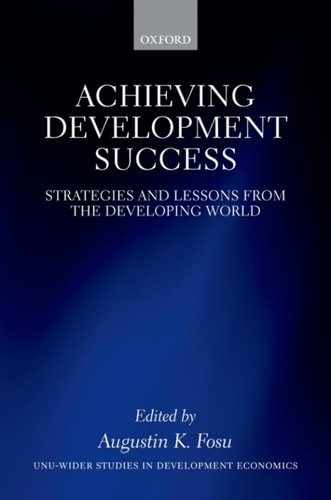
Achieving Development Success: Strategies and Lessons from the Developing World
0
0
As an Amazon Associate and affiliate partner, Menrva Books earns from qualifying purchases. Learn more
Author Description
This book presents development strategies and lessons based on a large range of 'success' countries across the developing world. In addition to the country cases, it presents regional and overall syntheses that cover orthodox vs. heterodox policies; the importance of capability, primary exports, diversification and financing; managing diversity; the role of institutions and governance; and human development. The book reveals much diversity in successful development strategies offered by the various select countries: for example, the 'disinterested-government' political economy of China; the democratically supported, high-service-sector development approach of India; the 'Washington-Consensus-based' reforms of Ghana and China; the diversification strategies of the United Arab Emirates (UAE), Bahrain and Oman; the dynamic orthodox-heterodox strategy of Malaysia and Vietnam; the effective natural-resource management of Botswana, Oman, Bahrain and the UAE; the social-sector underpinnings of development in Costa Rica and Tunisia; and the democratic political system of managing diversity in India. This refreshing approach to studying development will interest researchers, teachers, students, development practitioners and policymakers alike.
Menrva's Summary
THE THESIS
What specific economic and political strategies have enabled successful development outcomes across diverse nations in the developing world? Augustin K. Fosu, a prominent scholar in development economics, synthesizes empirical evidence from a wide array of successful developing nations to evaluate the efficacy of various policy frameworks. The book contrasts orthodox and heterodox approaches, arguing that there is no singular path to prosperity, but rather a complex interplay of institutional governance, human development, and strategic economic diversification.
THE SCOPE MAP
What You Will Find
- Comparative analysis of development models in China, India, Ghana, Malaysia, Vietnam, Botswana, and the UAE.
- Examination of natural resource management strategies in resource-rich economies.
- Evaluation of the role of political systems, including democratic and non-democratic governance, in fostering economic growth.
- Synthesis of policy impacts regarding primary exports, service-sector expansion, and social-sector investment.
Scope Limits
- The analysis focuses primarily on nations identified as 'success' cases, potentially omitting lessons from stagnant or failing economies.
- The text does not provide a prescriptive 'one-size-fits-all' manual for development, focusing instead on descriptive case studies and regional syntheses.
THE AUTHORITY PERSPECTIVE
Experts and development practitioners view this work as a valuable comparative resource for understanding the heterogeneity of successful economic growth models. Readers frequently note that the text provides a balanced, evidence-based perspective that is accessible to both academic researchers and policy professionals.
Page Count:
512
Publication Date:
2013-01-01
Publisher:
OUP Oxford
ISBN-10:
0191651311
ISBN-13:
9780191651311
Economics
Public Policy
Global Studies
International relations
Community Tags
Similar Books