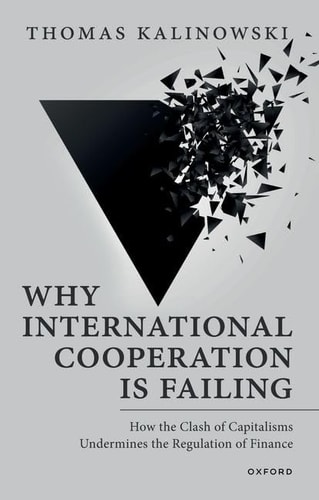
Why International Cooperation Is Failing: How the Clash of Capitalisms Undermines the Regulation of Finance
0
0
As an Amazon Associate and affiliate partner, Menrva Books earns from qualifying purchases. Learn more
Author Description
Ten years after the global financial crisis of 2008/09 there is widespread scepticism about the ability to curb volatile financial markets and achieve true international cooperation. Changes in the global rules of finance discussed in the G20 during the last decade remain limited, and it is uncertain whether they are suitable to help mitigate and manage future crises to come. This book offers an alternative to the popular notion that this failure is the result of the 'nature' of international relations, the clash of national egoisms, or ineffective national leadership. It instead provides an understanding of recent lapses in international cooperation by revealing their deeper structural origins in the competing models of capitalism operating across the globe.US finance-led, EU integration-led, and East Asian state-led capitalism complement each other globally yet have conflicting preferences on how to complement their distinct domestic regulations at the international level. This interdependence of capitalist models is relatively stable but also prone to crises caused by volatile financial flows, global economic imbalances, and 'currency wars'. To understand international economic cooperation, we must understand the diverse dynamics of the different models of capitalism on a domestic level, not only in financial markets but also in areas of corporate structure, labour markets, and welfare regimes.By establishing a deeper integration of approaches from International Political Economy and Comparative Capitalism, this book shows that regulating international finance is not a technocratic exercise of fine-tuning the machinery of international institutions, but rather a political process dependent on the dynamic of institutional change on a national and regional level.
Menrva's Summary
THE THESIS
This book investigates why international cooperation in financial regulation has largely failed to produce effective global oversight in the decade following the 2008 financial crisis. Thomas Kalinowski, an expert in international political economy, argues that these failures are not merely the result of national egoism or poor leadership. Instead, he posits that the structural incompatibility of competing models of capitalism—specifically US finance-led, EU integration-led, and East Asian state-led systems—creates inherent conflicts that prevent the harmonization of international financial rules.
THE SCOPE MAP
What You Will Find
- Analysis of the G20 financial regulatory agenda from 2008 to 2018.
- A comparative framework contrasting US, EU, and East Asian capitalist models.
- Examination of how domestic labor markets, corporate structures, and welfare regimes influence international policy preferences.
Scope Limits
- The book does not provide a comprehensive history of all global financial institutions.
- It does not offer a predictive model for future specific market crashes.
THE AUTHORITY PERSPECTIVE
Experts in international political economy recognize this work as a significant contribution to the study of how domestic institutional arrangements constrain global governance. Readers frequently note the academic density of the prose, which is well-suited for scholars and policy analysts interested in the intersection of comparative capitalism and international relations.
Page Count:
304
Publication Date:
2023-01-13
Publisher:
Oxford University Press
ISBN-10:
0192871447
ISBN-13:
9780192871442
Economics
Politics
Global Studies
Public Policy
Finance
Economic Policy & Development
Comparative Politics
Globalization
World politics
International business
International relations
Education & Reference
New Used & Rental Textbooks
Community Tags
Similar Books