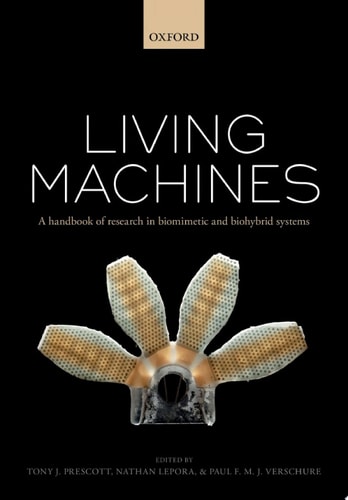
Living Machines: A Handbook of Research in Biomimetics and Biohybrid Systems
0
0
As an Amazon Associate and affiliate partner, Menrva Books earns from qualifying purchases. Learn more
Author Description
Contemporary research in science and engineering is seeking to harness the versatility and sustainability of living organisms. By exploiting natural principles, researchers hope to create new kinds of technology that are self-repairing, adaptable, and robust, and to invent a new class of machines that are perceptive, social, emotional, perhaps even conscious. This is the realm of the 'living machine'. Living machines can be divided into two types: biomimetic systems, that harness the principles discovered in nature and embody them in new artifacts, and biohybrid systems in which biological entities are coupled with synthetic ones. Living Machines: A handbook of research in biomimetic and biohybrid systems surveys this flourishing area of research, capturing the current state of play and pointing to the opportunities ahead. Promising areas in biomimetics include self-organization, biologically inspired active materials, self-assembly and self-repair, learning, memory, control architectures and self-regulation, locomotion in air, on land or in water, perception, cognition, control, and communication. Drawing on these advances the potential of biomimetics is revealed in devices that can harvest energy, grow or reproduce, and in animal-like robots that range from synthetic slime molds, to artificial fish, to humanoids. Biohybrid systems is a relatively new field, with exciting and largely unknown potential, but one that is likely to shape the future of humanity. This book surveys progress towards new kinds of biohybrid such as robots that merge electronic neurons with biological tissue, micro-scale machines made from living cells, prosthetic limbs with a sense of touch, and brain-machine interfaces that allow robotic devices to be controlled by human thought. The handbook concludes by exploring some of the impacts that living machine technologies could have on both society and the individual, exploring questions about how we will see and understand ourselves in a world
Menrva's Summary
THE THESIS
This handbook investigates the intersection of biological principles and synthetic engineering to determine how living organisms can inform the development of self-repairing, adaptable, and robust technologies. The authors, Nathan Lepora, Paul F. M. J. Verschure, and Tony J. Prescott, compile research from leading experts to define the current state of biomimetic and biohybrid systems. They argue that by integrating biological mechanisms into artificial structures, researchers can create a new class of machines capable of perception, cognition, and social interaction.
THE SCOPE MAP
What You Will Find
- Analysis of biomimetic principles including self-organization, self-repair, and locomotion.
- Overviews of biohybrid technologies such as brain-machine interfaces and cell-based micro-machines.
- Discussions on the societal and ethical implications of integrating biological tissue with electronic systems.
Scope Limits
- The text focuses on current research trajectories rather than providing a comprehensive history of robotics.
- It does not offer speculative science fiction scenarios but remains grounded in existing engineering and biological frameworks.
THE AUTHORITY PERSPECTIVE
Experts recognize this volume as a foundational survey for researchers and students entering the fields of bio-inspired engineering and robotics. Readers frequently note the academic density of the prose, which serves as a comprehensive reference for the technical challenges and potential applications of living machine technologies.
Page Count:
653
Publication Date:
2018-01-01
Publisher:
OUP Oxford
ISBN-10:
0191666815
ISBN-13:
9780191666810
Science
Medical
Robotics
Allied Health
Technology
Biomimetics
Bioengineering
Community Tags
Similar Books







Reader Comments
Share Your Thoughts
No comments yet. Be the first to share your thoughts!