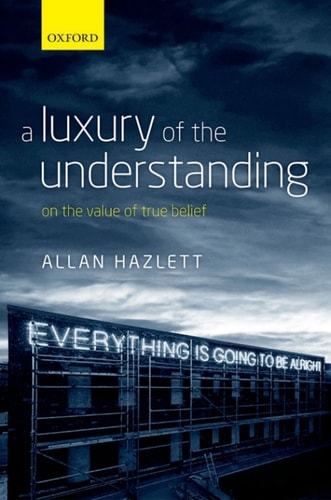
A Luxury of the Understanding: On the Value of True Belief
0
0
As an Amazon Associate and affiliate partner, Menrva Books earns from qualifying purchases. Learn more
Author Description
The value of true belief has played a central role in history of philosophy--consider Socrates' slogan that the unexamined life is not worth living, and Aristotle's claim that everyone naturally wants knowledge--as well as in contemporary epistemology, where questions about the value of knowledge have recently taken center stage. It has usually been assumed that accurate representation--true belief--is valuable, either instrumentally or for its own sake. In A Luxury of the Understanding, Allan Hazlett offers a critical study of that assumption, and of the main ways in which it can be defended. Hazlett defends the conclusion that true belief is at most sometimes valuable. In the first part of the book, he targets the view that true belief is normally better for us than false belief, and argues that false beliefs about ourselves--for example, unrealistic optimism about our futures and about other people, such as overly positive views of our friends--are often valuable vis-à-vis our wellbeing. In the second part, he targets the view that truth is "the aim of belief," and argues for anti-realism about the epistemic value of true belief. Together, these arguments comprise a challenge to the philosophical assumption of the value of true belief, and suggest an alternative picture, on which the fact that some people love truth is all there is to "the value of true belief".
Menrva's Summary
THE THESIS
This book investigates the philosophical assumption that true belief is inherently valuable, challenging the long-standing consensus in epistemology. Allan Hazlett, a philosopher specializing in epistemology and the philosophy of language, utilizes a combination of conceptual analysis and psychological observation to argue that the value of truth is contingent rather than absolute. He systematically deconstructs the notion that accurate representation is always beneficial, proposing instead that the value of belief is tied to individual human preference rather than an objective epistemic aim.
THE SCOPE MAP
What You Will Find
- A critical examination of the 'truth as the aim of belief' doctrine
- Analysis of the psychological benefits of false beliefs, such as unrealistic optimism
- Arguments for anti-realism regarding epistemic value
- Philosophical inquiry into the relationship between well-being and accurate representation
Scope Limits
- The text does not provide a comprehensive history of all epistemological theories regarding truth
- It does not offer a practical guide for managing personal beliefs in daily life
THE AUTHORITY PERSPECTIVE
Experts in the field of epistemology recognize this work as a provocative challenge to traditional value-of-knowledge debates. Readers frequently note the academic density of the prose, which is intended for those already familiar with contemporary philosophical discourse.
Page Count:
320
Publication Date:
2013-01-01
Publisher:
OUP Oxford
ISBN-10:
0191662461
ISBN-13:
9780191662461
Philosophy
Non-Fiction
Epistemology
Ethics
Community Tags
Similar Books