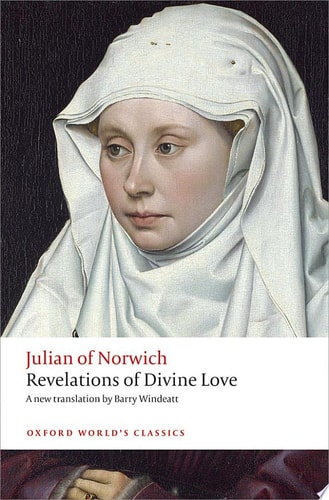
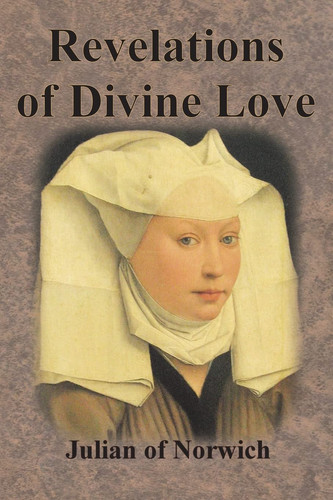
Revelations of Divine Love
0
0
As an Amazon Associate and affiliate partner, Menrva Books earns from qualifying purchases. Learn more
Author Description
Revelations of Divine Love is a medieval book of Christian mystical devotions. It was written between the 14th and 15th centuries by Julian of Norwich, about whom almost nothing is known. It is the earliest surviving example of a book in the English language known to have been written by a woman. It is also the earliest surviving work written by an English anchorite or anchoress. Julian, who lived all her life in the English city of Norwich, wrote about the sixteen mystical visions or "shewings" she received in 1373, when she was in her thirties. Whilst seriously ill, and believing to be on her deathbed, the visions appeared to her over a period of several hours in one night, with a final revelation occurring the following night. After making a full recovery, she wrote an account of each vision, producing a manuscript now referred to as the Short Text. She developed her ideas over a period of decades, whilst living as an anchoress in a cell attached to St Julian's Church, Norwich, and wrote a far more extended version of her writings, now known as the Long Text. She wrote straightforwardly in Middle English. Julian's work was preserved by others. Various manuscripts of both the Long Text and the Short Text, in addition to extracts, have survived. The first publication of the book was a translation of the Long Text in 1670 by the English Benedictine monk Serenus de Cressy. Interest in Julian's writings increased with the publication of three versions of Cressy's book in the nineteenth century, and in 1901, Grace Warrack's translation of the manuscript of the Long Text known as 'Sloane 2499' introduced the book to twentieth-century readers. Many other versions of Julian's book have since been published, in English and in other languages. (wikipedia.org)
Menrva's Summary
THE THESIS
This work investigates the nature of divine love and the theological implications of sixteen mystical visions experienced by a fourteenth-century anchoress. Julian of Norwich, writing from the seclusion of her cell in Norwich, documents her intense spiritual experiences during a period of severe illness. She utilizes these visions to construct a framework of optimism regarding human salvation, emphasizing the concept of God as both mother and father, and arguing for the ultimate reconciliation of all creation with the divine.
THE SCOPE MAP
What You Will Find
- Detailed accounts of sixteen mystical 'shewings' or visions.
- Theological reflections on the nature of sin, suffering, and divine compassion.
- Comparative analysis between the 'Short Text' and the 'Long Text' manuscripts.
Scope Limits
- The text does not provide biographical details regarding the author's life outside of her spiritual experiences.
- It does not offer a systematic or academic theological treatise in the modern sense, but rather a personal, experiential account.
THE AUTHORITY PERSPECTIVE
Scholars and theologians recognize this work as a foundational text in English mystical literature and a significant contribution to medieval Christian thought. Readers frequently note the accessibility of the prose despite its medieval origins, often citing the author's unique focus on divine mercy as a point of enduring interest.
Page Count:
272
Publication Date:
2015-01-01
Publisher:
Oup Oxford
ISBN-10:
0191662259
ISBN-13:
9780191662256
History
Autobiography
Spirituality
Christian mysticism
Medieval
Theology
Religious History
Community Tags
Other Editions(24)

National Book Network
2024
Default edition
christianaudio and Blackstone Publishing
2021
Amazon Digital Services LLC - KDP Print US
2020

Independently Published
2020
Wilder Publications
2018

CreateSpace Independent Publishing Platform
2017
CreateSpace Independent Publishing Platform
2017

CreateSpace Independent Publishing Platform
2017
CreateSpace Independent Publishing Platform
2017

CreateSpace Independent Publishing Platform
2016
Paraclete Press, Incorporated
2016

CreateSpace Independent Publishing Platform
2015
Oup Oxford
2015
OUP Oxford
2015

CreateSpace Independent Publishing Platform
2014

Aziloth Books
2013

Dover Publications
2012
Paraclete Press
2011

General Books LLC
2010

Benediction Classics
2009

Cosimo, Inc.
2007

ReadHowYouWant.com, Limited
2006

Templegate Publishers
2002
Chump Change
1901
Similar Books
Reader Comments
Share Your Thoughts
No comments yet. Be the first to share your thoughts!