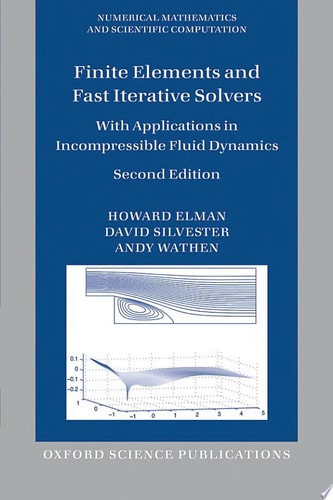
Finite Elements and Fast Iterative Solvers: With Applications in Incompressible Fluid Dynamics
0
0
As an Amazon Associate and affiliate partner, Menrva Books earns from qualifying purchases. Learn more
Author Description
This book is a description of why and how to do Scientific Computing for fundamental models of fluid flow. It contains introduction, motivation, analysis, and algorithms and is closely tied to freely available MATLAB codes that implement the methods described. The focus is on finite element approximation methods and fast iterative solution methods for the consequent linear(ized) systems arising in important problems that model incompressible fluid flow. The problems addressed are the Poisson equation, Convection-Diffusion problem, Stokes problem and Navier-Stokes problem, including new material on time-dependent problems and models of multi-physics. The corresponding iterative algebra based on preconditioned Krylov subspace and multigrid techniques is for symmetric and positive definite, nonsymmetric positive definite, symmetric indefinite and nonsymmetric indefinite matrix systems respectively. For each problem and associated solvers there is a description of how to compute together with theoretical analysis that guides the choice of approaches and describes what happens in practice in the many illustrative numerical results throughout the book (computed with the freely downloadable IFISS software). All of the numerical results should be reproducible by readers who have access to MATLAB and there is considerable scope for experimentation in the "computational laboratory " provided by the software. Developments in the field since the first edition was published have been represented in three new chapters covering optimization with PDE constraints (Chapter 5); solution of unsteady Navier-Stokes equations (Chapter 10); solution of models of buoyancy-driven flow (Chapter 11). Each chapter has many theoretical problems and practical computer exercises that involve the use of the IFISS software. This book is suitable as an introduction to iterative linear solvers or more generally as a model of Scientific Computing at an advanced undergraduate or beginning graduate level
Menrva's Summary
THE THESIS
This text investigates the mathematical foundations and computational strategies required to solve partial differential equations governing incompressible fluid flow. The authors, experts in numerical linear algebra and finite element methods, provide a rigorous framework that bridges theoretical analysis with practical implementation. By focusing on the interplay between finite element discretization and iterative linear solvers, the book establishes a methodology for addressing complex systems arising in fluid dynamics.
THE SCOPE MAP
What You Will Find
- Finite element approximation methods for Poisson, Convection-Diffusion, Stokes, and Navier-Stokes equations.
- Preconditioned Krylov subspace and multigrid techniques for various matrix systems.
- Integration with the IFISS software package for reproducible numerical experimentation.
- Advanced topics including optimization with PDE constraints and buoyancy-driven flow.
Scope Limits
- The text assumes a foundational knowledge of linear algebra and numerical analysis.
- It focuses specifically on incompressible fluid flow models rather than compressible or high-speed aerodynamics.
THE AUTHORITY PERSPECTIVE
Experts recognize this work as a standard reference for students and researchers bridging the gap between numerical theory and software implementation. Readers frequently note the high level of technical density, which makes it a rigorous resource for those seeking to master iterative solvers in a computational laboratory setting.
Page Count:
498
Publication Date:
2014-01-01
Publisher:
OUP Oxford
ISBN-10:
0191667927
ISBN-13:
9780191667923
Mathematics - General
Mathematics Statistics
Computational Physics
Scientific Computing
Engineering
Iterative methods Mathematics
Mathematics
Numerical analysis
Fluid dynamics
Community Tags
Similar Books













Reader Comments
Share Your Thoughts
No comments yet. Be the first to share your thoughts!