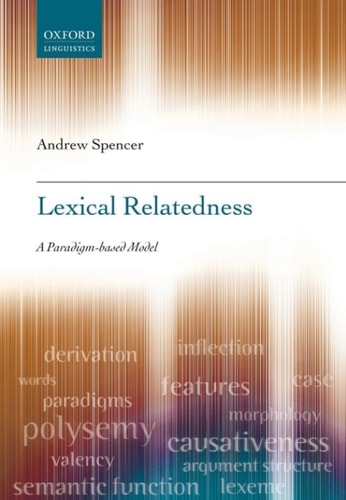
Lexical Relatedness: A Paradigm-Based Model
0
0
As an Amazon Associate and affiliate partner, Menrva Books earns from qualifying purchases. Learn more
Author Description
This book argues (a) that there is no principled way to distinguish inflection and derivation and (b) that this fatally undermines conventional approaches to morphology. Conceptual shortcomings in the relation between derivational and lexically-derived word forms, Andrew Spencer suggests, call into question the foundation of the inferential-derivational approach. Prototypical instances of inflection and derivation are separated by a host of intermediate types of lexical relatedness, some discussed in the literature, others ignored. Far from finding these an embarrassment Professor Spencer deploys the wealth of types of relatedness in a variety of languages (including Slavic, Uralic, Australian, Germanic, and Romance) to develop an enriched and morphologically-informed model of the lexical entry. He then uses this to build the foundations for a model of lexical relatedness that is consistent with paradigm-based models. Lexical Relatedness is a profound and stimulating book. It will interest all morphologists, lexicographers, and theoretical linguists more generally.
Menrva's Summary
THE THESIS
This book investigates whether the traditional distinction between inflection and derivation is theoretically sound and proposes a paradigm-based model to replace conventional morphological approaches. Andrew Spencer, a noted linguist, challenges the binary classification of word-formation processes by highlighting the existence of intermediate types of lexical relatedness. By analyzing data across diverse language families, he argues that current models fail to account for the complexity of lexical entries and proposes a more robust, morphologically-informed framework.
THE SCOPE MAP
What You Will Find
- A comparative analysis of lexical relatedness across Slavic, Uralic, Australian, Germanic, and Romance languages
- A critique of the inferential-derivational approach to morphology
- A proposed paradigm-based model for the structure of the lexical entry
Scope Limits
- The text does not provide a comprehensive dictionary or exhaustive catalog of all known morphological phenomena
- The analysis is restricted to theoretical morphology and does not focus on applied computational linguistics or language acquisition
THE AUTHORITY PERSPECTIVE
Linguists and morphologists frequently cite this work as a significant challenge to standard morphological theory. Readers often note the high level of academic density and the rigorous cross-linguistic evidence required to follow the author's argument.
Page Count:
448
Publication Date:
2013-01-01
Publisher:
OUP Oxford
ISBN-10:
0191669520
ISBN-13:
9780191669521
English & College Success
Reference
Morphology
English
Language Theory
Linguistics
Academic
Community Tags
Similar Books