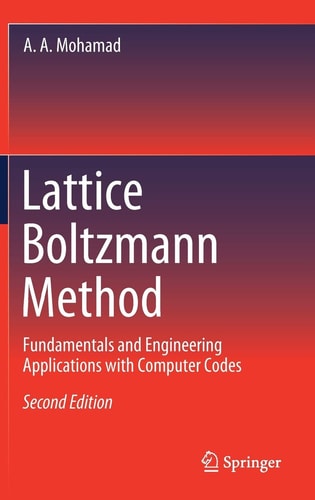
Lattice Boltzmann Method Fundamentals and Engineering Applications with Computer Codes
0
0
As an Amazon Associate and affiliate partner, Menrva Books earns from qualifying purchases. Learn more
Author Description
This book introduces readers to the lattice Boltzmann method (LBM) for solving transport phenomena – flow, heat and mass transfer – in a systematic way. Providing explanatory computer codes throughout the book, the author guides readers through many practical examples, such as: • flow in isothermal and non-isothermal lid-driven cavities; • flow over obstacles; • forced flow through a heated channel; • conjugate forced convection; and • natural convection. Diffusion and advection–diffusion equations are discussed, together with applications and examples, and complete computer codes accompany the sections on single and multi-relaxation-time methods. The codes are written in MatLab. However, the codes are written in a way that can be easily converted to other languages, such as FORTRANm Python, Julia, etc. The codes can also be extended with little effort to multi-phase and multi-physics, provided the physics of the respective problem are known. The second edition of this book adds new chapters, and includes new theory and applications. It discusses a wealth of practical examples, and explains LBM in connection with various engineering topics, especially the transport of mass, momentum, energy and molecular species. This book offers a useful and easy-to-follow guide for readers with some prior experience with advanced mathematics and physics, and will be of interest to all researchers and other readers who wish to learn how to apply LBM to engineering and industrial problems. It can also be used as a textbook for advanced undergraduate or graduate courses on computational transport phenomena
Menrva's Summary
THE THESIS
This book systematically introduces the Lattice Boltzmann Method (LBM) for solving transport phenomena, including flow, heat, and mass transfer, with practical engineering applications. The author, A. A. Mohamad, guides readers through numerous examples using explanatory computer codes written in MatLab, which can be easily adapted to other programming languages. The text covers essential LBM concepts, diffusion, and advection-diffusion equations, applying them to specific engineering problems. The second edition expands upon these topics with new chapters, theories, and applications, making it a valuable resource for researchers and students in computational transport phenomena.
THE SCOPE MAP
- Introduction to the Lattice Boltzmann Method (LBM) for transport phenomena.
- Detailed explanations and MatLab computer codes for practical examples.
- Applications in isothermal and non-isothermal lid-driven cavities.
- Analysis of flow over obstacles and forced flow through a heated channel.
- Coverage of conjugate forced convection and natural convection.
- Discussion of diffusion and advection-diffusion equations.
- Guidance on extending codes for multi-phase and multi-physics problems.
- New chapters, theories, and applications in the second edition.
THE AUTHORITY PERSPECTIVE
The book is presented as a useful and easy-to-follow guide for individuals with a background in advanced mathematics and physics. It aims to be of interest to researchers and practitioners seeking to apply LBM in engineering and industrial contexts. The text is also suitable as a textbook for advanced undergraduate or graduate courses focusing on computational transport phenomena. The inclusion of computer codes and practical examples is highlighted as a key feature for learning and application.
Page Count:
222
Publication Date:
2019-05-16
Publisher:
Springer London
ISBN-10:
1447174224
ISBN-13:
9781447174226
Science
Non-Fiction
Heat Transfer
Mass Transfer
Numerical Methods
Community Tags
Other Editions(4)

Similar Books
Reader Comments
Share Your Thoughts
No comments yet. Be the first to share your thoughts!