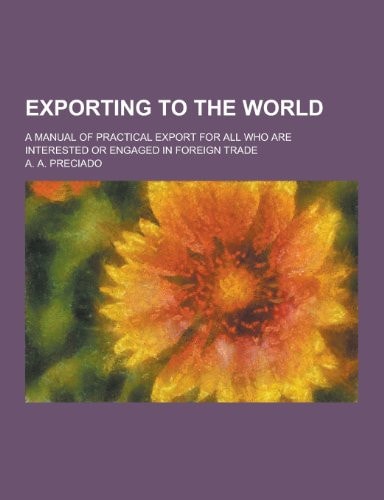
Exporting to the World: A Manual of Practical Export for All Who Are Interested Or Engaged in Foreign Trade
0
0
As an Amazon Associate and affiliate partner, Menrva Books earns from qualifying purchases. Learn more
Author Description
This historic book may have numerous typos and missing text. Purchasers can usually download a free scanned copy of the original book (without typos) from the publisher. Not indexed. Not illustrated. 1920 edition. Excerpt:... 1 Chapter XII FOREIGN CREDITS Human Nature Same The World Over--Why Manufacturers Refuse To Extend Credit Overseas Hlstory Of Credit In ForEIGN Business--Credit Information Not Difficult To ObTain--What Is Necessary In Credit Information--Long Credits Not Necessary In Export Trade--How To Collect Overdue Accounts In Foreign Field. All the crooks and "dead beats" in the world are not to be found in regions outside of the United States. Neither are all the honest folks concentrated in this country. Yet the novice in export trade upon receiving an inquiry or an order from a merchant in a foreign country generally demands cash in advance before he permits the goods to leave his hands. He has formed the opinion that foreigners are not to be trusted. There is another kind of a novice in the export trade, too. He is the exporter who become DEGREES so enthusiastic over receiving his first order from some merchant in India or in South Africa that he immediately makes the shipment without consulting the credit information sources which are available. The shipment reaches its destination but the remittance never comes; and the novice is greatly disappointed. Human nature is very much the same the world over. Business is transacted along the same basic principles. There arc good and bad accounts in foreign countries. There are good and bad accounts in the United States. Business cannot be transacted without credit, however. The world's greatest exporting nations have developed the markets of the world by extending credit. American manufacturers and exporters have extended credit. The pioneers will tell the novice that fewer losses from bad accounts have been recorded against foreign customers than against domestic buyers. There are still many American...
Menrva's Summary
THE THESIS
This manual addresses the practicalities of extending credit and managing collections in international trade, challenging the notion that foreign customers are inherently untrustworthy. The author, A. A. Preciado, argues that basic business principles and human nature are consistent globally, and that American manufacturers often err by either demanding cash in advance or shipping without due diligence. The book aims to provide necessary credit information and demonstrate that long credit terms are not essential for successful export operations, drawing on historical practices and the experiences of pioneering exporters.
THE SCOPE MAP
- What is necessary in credit information for foreign trade.
- Methods for obtaining credit information on overseas clients.
- The history and evolution of credit practices in international business.
- Strategies for collecting overdue accounts from foreign buyers.
- Analysis of why manufacturers hesitate to extend credit abroad.
- Discussion on the universality of human nature in business dealings.
- The role of credit in developing global markets.
- Comparison of losses from bad accounts with domestic versus foreign customers.
THE AUTHORITY PERSPECTIVE
This 1920 manual offers a historical perspective on export trade practices, focusing on the critical aspects of credit and collections. The provided excerpt suggests a practical, advice-driven approach, aiming to educate novice exporters on building trust and managing financial risks in international dealings. The text emphasizes that sound credit practices, rather than outright distrust, are key to successful global commerce, drawing parallels between domestic and foreign business environments. It appears to be a foundational text for understanding early 20th-century export finance.
Page Count:
154
Publication Date:
2013-09-01
Publisher:
General Books
ISBN-10:
1230285857
ISBN-13:
9781230285856
Business
Non-Fiction
Trade
Credit
Exporting
International Trade
Finance
Community Tags
Similar Books



Reader Comments
Share Your Thoughts
No comments yet. Be the first to share your thoughts!