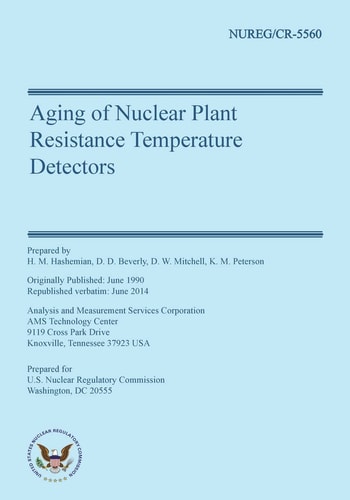
Aging of Nuclear Plant Resistance Temperature Detectors
0
0
As an Amazon Associate and affiliate partner, Menrva Books earns from qualifying purchases. Learn more
Author Description
This report provides key results of a 30-month experimental research and development project to identify and quantify the effects of normal aging on the performance of nuclear safety-related resistance temperature detectors (RTDs). The limit for initial accuracy of RTD elements was established and the range of their response time was determined. Seventy-two representative nuclear-grade RTDs were tested for calibration drift at simulated reactor conditions and for shelf-life drift. This included a number of naturally aged RTDs received from nuclear power plants. The authors demonstrate that periodic calibration and response time testing performed once every fuel cycle is a reasonable approach for managing the aging of nuclear grade RTDs.
Menrva's Summary
THE THESIS
This report details the findings of a 30-month research project investigating the aging effects on nuclear safety-related resistance temperature detectors (RTDs). The project established the initial accuracy limits and response time ranges for RTD elements, testing seventy-two nuclear-grade RTDs under simulated reactor conditions and for shelf-life drift. This included RTDs that had already undergone aging in operational nuclear power plants. The research demonstrates that the proposed approach of periodic calibration and response time testing, conducted once per fuel cycle, is a sound method for managing the aging of these critical components.
THE SCOPE MAP
- Key results from a 30-month experimental research and development project.
- Identification and quantification of normal aging effects on RTD performance.
- Establishment of the limit for initial accuracy of RTD elements.
- Determination of the range of RTD response times.
- Testing of seventy-two representative nuclear-grade RTDs.
- Calibration drift analysis under simulated reactor conditions.
- Shelf-life drift analysis.
- Inclusion of naturally aged RTDs from nuclear power plants.
- Demonstration of periodic calibration and response time testing as a management strategy.
THE AUTHORITY PERSPECTIVE
The research presented in this report offers a data-driven approach to managing the aging of critical RTD components in nuclear power plants. By establishing accuracy limits and response time ranges through extensive testing, the authors provide a foundation for effective maintenance strategies. The inclusion of naturally aged RTDs from operational plants lends significant practical relevance to the findings. The conclusion that periodic calibration and response time testing every fuel cycle is a reasonable management strategy is supported by the experimental results.
Page Count:
260
Publication Date:
2014-06-13
Publisher:
CreateSpace Independent Publishing Platform
ISBN-10:
1499558988
ISBN-13:
9781499558982
Science & Technology
Science
Non-Fiction
Nuclear Engineering
Engineering
Community Tags
Similar Books