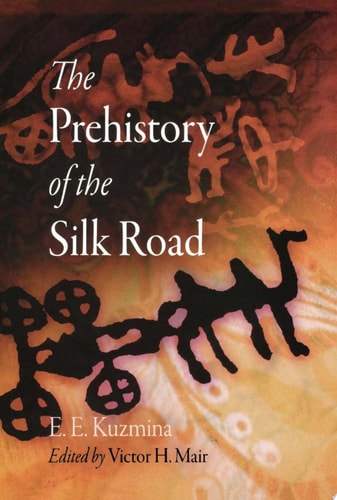
The Prehistory of the Silk Road
0
0
As an Amazon Associate and affiliate partner, Menrva Books earns from qualifying purchases. Learn more
Author Description
In ancient and medieval times, the Silk Road was of great importance to the transport of peoples, goods, and ideas between the East and the West. A vast network of trade routes, it connected the diverse geographies and populations of China, the Eurasian Steppe, Central Asia, India, Western Asia, and Europe. Although its main use was for importing silk from China, traders moving in the opposite direction carried to China jewelry, glassware, and other exotic goods from the Mediterranean, jade from Khotan, and horses and furs from the nomads of the Steppe. In both directions, technology and ideologies were transmitted. The Silk Road brought together the achievements of the different peoples of Eurasia to advance the Old World as a whole. The majority of the Silk Road routes passed through the Eurasian Steppe, whose nomadic people were participants and mediators in its economic and cultural exchanges. Until now, the origins of these routes and relationships have not been examined in great detail. In The Prehistory of the Silk Road, E. E. Kuzmina, renowned Russian archaeologist, looks at the history of this crucial area before the formal establishment of Silk Road trade and diplomacy. From the late Neolithic period to the early Bronze Age, Kuzmina traces the evolution of the material culture of the Steppe and the contact between civilizations that proved critical to the development of the widespread trade that would follow, including nomadic migrations, the domestication and use of the horse and the camel, and the spread of wheeled transport. The Prehistory of the Silk Road combines detailed research in archaeology with evidence from physical anthropology, linguistics, and other fields, incorporating both primary and secondary sources from a range of languages, including a vast accumulation of Russian-language scholarship largely untapped in the West. The book is complemented by an extensive bibliography that will be of great use to scholar
Menrva's Summary
THE THESIS
The Prehistory of the Silk Road investigates the origins and development of the crucial trade networks that would later become known as the Silk Road, focusing on the period before its formal establishment. Renowned Russian archaeologist E. E. Kuzmina examines the material culture and inter-civilizational contacts of the Eurasian Steppe from the late Neolithic to the early Bronze Age. The book traces the evolution of nomadic migrations, the domestication of the horse and camel, and the spread of wheeled transport, all of which proved critical to the subsequent development of widespread trade. Kuzmina synthesizes detailed archaeological research with evidence from physical anthropology and linguistics, drawing on a vast body of Russian-language scholarship previously untapped in the West.
THE SCOPE MAP
- The evolution of material culture on the Eurasian Steppe from the late Neolithic to the early Bronze Age.
- The role of nomadic peoples as participants and mediators in early Eurasian exchanges.
- Evidence for the domestication and use of the horse and camel in pre-Silk Road societies.
- The spread and impact of wheeled transport technology in ancient Eurasia.
- Analysis combining archaeology, physical anthropology, and linguistics.
- Incorporation of primary and secondary sources from multiple languages, including extensive Russian scholarship.
- An extensive bibliography for further scholarly research.
THE AUTHORITY PERSPECTIVE
E. E. Kuzmina's "The Prehistory of the Silk Road" is recognized for its comprehensive synthesis of archaeological and linguistic evidence, drawing heavily on Russian scholarship to illuminate the formative period of Eurasian trade networks. The book is noted for its detailed research into the material culture and technological developments of the Steppe peoples, providing a foundational understanding of the exchanges that predated the formal Silk Road. Scholars have highlighted its interdisciplinary approach and extensive bibliography as valuable resources for further study in ancient history and archaeology. The work is considered a significant contribution to understanding the deep historical roots of East-West connectivity.
Page Count:
264
Publication Date:
2015-02-23
Publisher:
University of Pennsylvania Press
ISBN-10:
0812292332
ISBN-13:
9780812292336
History
Non-Fiction
Archaeology
Trade Routes
Community Tags
Similar Books