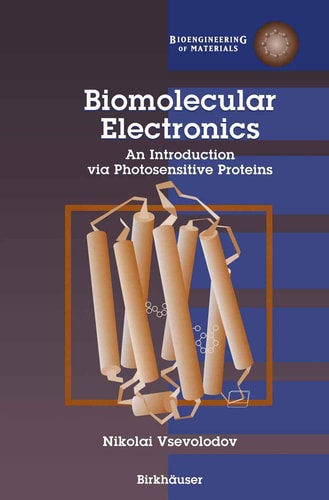
Biomolecular Electronics: An Introduction Via Photosensitive Proteins
0
0
As an Amazon Associate and affiliate partner, Menrva Books earns from qualifying purchases. Learn more
Author Description
The properties of materials depend on the nature of the macromolecules, small molecules and inorganic components and the interfaces and interactions between them. Polymer chemistry and physics, and inorganic phase structure and density are major factors that influence the performance of materials. In addition, molecular recognition, organic-inorganic interfaces and many other types of interactions among components are key issues in determining the properties of materials for a wide range of applications. Materials require ments are becoming more and more specialized to meet increasingly demand ing needs, from specific environmental stresses to high performance or biomedical applications such as matrices for controlled release tissue scaf folds. One approach to meet these performance criteria is to achieve better control over the tailoring of the components and their interactions that govern the material properties. This goal is driving a great deal of ongoing research in material science laboratories. In addition, control at the molecular level of interactions between these components is a key in many instances in order to reach this goal since traditional approaches used to glue, stitch or fasten parts together can no longer suffice at these new levels of manipulation to achieve higher performance. In many cases, molecular recognition and self-assembly must begin to drive these processes to achieve the levels of control desired. This same need for improved performance has driven Nature over millenia to attain higher and higher complexity.
Menrva's Summary
THE THESIS
This book explores the fundamental principles of biomolecular electronics, focusing on photosensitive proteins as a key component. It delves into how the properties of materials are dictated by their constituent macromolecules, small molecules, and inorganic elements, as well as the interactions between them. The text highlights the increasing demand for specialized materials in various applications, from environmental stress resistance to advanced biomedical uses, and how molecular recognition and self-assembly are crucial for achieving desired material properties.
THE SCOPE MAP
- Introduction to biomolecular electronics and its significance.
- Detailed examination of photosensitive proteins and their electronic properties.
- Discussion of macromolecular, small molecule, and inorganic components in materials.
- Exploration of molecular recognition and self-assembly principles.
- Applications of biomolecular materials in controlled release and tissue engineering.
- The role of interfaces and interactions in determining material performance.
- Comparison of engineered materials with naturally evolved complex systems.
THE AUTHORITY PERSPECTIVE
This text is presented as an introductory volume to the field of biomolecular electronics, with a specific emphasis on photosensitive proteins. The subject matter suggests a focus on the fundamental science and engineering principles underlying the creation and application of advanced materials. The author's approach likely aims to bridge concepts from polymer chemistry, physics, and molecular biology to address the growing need for specialized materials in high-performance and biomedical contexts.
Page Count:
275
Publication Date:
1998-01-01
Publisher:
Birkhäuser Boston
ISBN-10:
0817638520
ISBN-13:
9780817638528
Non-Fiction
Science
Biotechnology
Proteins
Biophysics