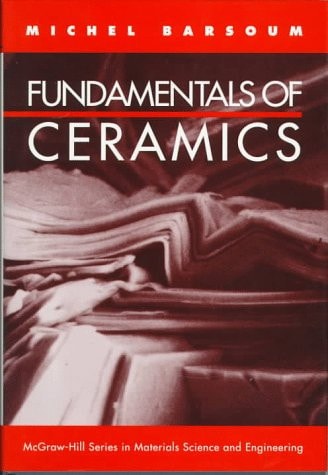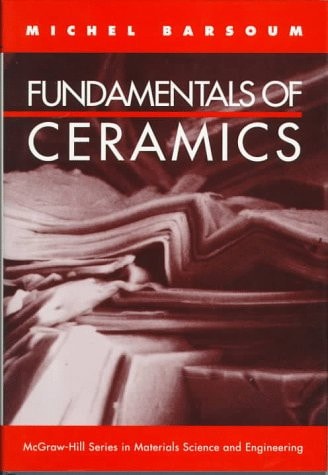
Fundamentals of Ceramics
0
0
As an Amazon Associate and affiliate partner, Menrva Books earns from qualifying purchases. Learn more
Author Description
Introduces the fundamentals of ceramics, with an emphasis on solid-state physics and chemistry. The first nine chapters deal with bonding, structure, and the physical and chemical properties that are influenced mostly by the type of bonding rather than the microstructure, such as defect structure and the atomic and electronic transport in ceramics. The next set of chapters deal with properties that are more microstructure-dependent, such as fracture toughness, optical, magnetic, and dielectric properties. A separate chapter deals with the science of sintering and microstructural development. Annotation c. by Book News, Inc., Portland, Or.
Menrva's Summary
THE THESIS
This text investigates the fundamental principles governing the behavior of ceramic materials through the lens of solid-state physics and chemistry. Michel W. Barsoum, a distinguished professor in the Department of Materials Science and Engineering, utilizes his academic expertise to construct a comprehensive framework that bridges atomic-level bonding with macroscopic material performance. The book systematically organizes complex physical phenomena into a logical progression, moving from intrinsic atomic properties to the extrinsic effects of microstructure.
THE SCOPE MAP
What You Will Find
- Analysis of atomic bonding and crystal structures
- Examination of defect chemistry and transport mechanisms
- Detailed study of fracture toughness and mechanical behavior
- Overview of optical, magnetic, and dielectric properties
- Methodology for understanding sintering and microstructural evolution
Scope Limits
- Does not cover advanced industrial manufacturing processes in depth
- Excludes extensive historical context of ceramic development
THE AUTHORITY PERSPECTIVE
Experts and educators frequently cite this work as a foundational text for undergraduate and graduate students in materials science. Readers often note the academic density of the prose, which requires a solid background in physics and chemistry to fully grasp the presented concepts.
Page Count:
568
Publication Date:
1996-10-29
Publisher:
McGraw-Hill College
ISBN-10:
0070055211
ISBN-13:
9780070055216
textbook
Ceramics
Solid-State Physics
Chemistry
Chemical
Engineering
New Used & Rental Textbooks
Community Tags
Other Editions(3)
Similar Books