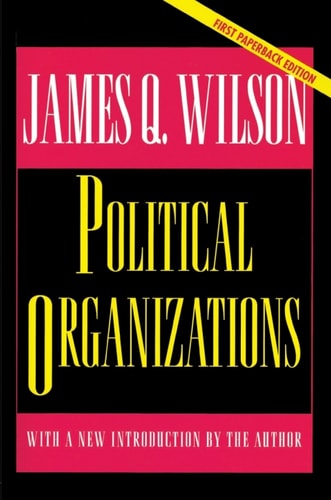
Political Organizations Updated Edition
0
0
As an Amazon Associate and affiliate partner, Menrva Books earns from qualifying purchases. Learn more
Author Description
A major work by one of America's eminent political scientists, Political Organizations has had a profound impact on how we view the influence of interest groups on policymaking. James Wilson wrote this book to counter two ideas: that popular interests will automatically generate political organizations and that such organizations will faithfully mirror the opinions and interests of their members. Moreover, he demonstrated that the way in which political organizations (including parties, business groups, labor unions, and civil rights associations) are created and maintained has a profound impact on the opinions they represent and the tactics they use. Now available for the first time in paperback, this book has broadened its scope to include recently developed organizations as it addresses many of today's concerns over the power of such groups as special-interest lobbies. In 1973, when this book was first published, the press and public were fascinated by the social movements of the 1960s, thinking that the antiwar and civil rights movements might sweep aside old-fashioned interest-group lobbies. Wilson argued, however, that such movements would inevitably be supplanted by new organizations, ones with goals and tactics that might direct the course of action away from some of the movements' founding principles. In light of the current popular distress with special-interest groups and their supposed death-grip on Congress, Wilson again attempts to modify a widely held view. He shows that although lobbies have multiplied in number and kind, they remain considerably constrained by the difficulty they have in maintaining themselves.
Menrva's Summary
THE THESIS
This book investigates the complex relationship between the formation and maintenance of political organizations and their subsequent influence on policymaking and representation.
THE SCOPE MAP
- Analysis of how political organizations, including parties, business groups, labor unions, and civil rights associations, are created and sustained.
- Examination of the counter-argument that popular interests do not automatically generate political organizations and that these organizations do not always mirror their members' opinions.
- Discussion of the impact of organizational structure and maintenance on the opinions represented and tactics employed by these groups.
- Consideration of the evolution of organizations, including the rise of special-interest lobbies and their constraints.
- Re-evaluation of the influence of social movements versus traditional interest groups on policy.
THE AUTHORITY PERSPECTIVE
As a seminal work by a prominent political scientist, James Q. Wilson's 'Political Organizations' has significantly shaped the understanding of interest groups' role in policy. The updated edition addresses contemporary concerns about lobbying power while reinforcing Wilson's original arguments about the inherent difficulties in maintaining organizational cohesion and influence. The book is recognized for its rigorous analysis of organizational dynamics and their impact on political outcomes. Its enduring relevance lies in its nuanced perspective on how the structure of organizations, rather than just their stated goals, directs political action.
Page Count:
387
Publication Date:
2021-02-09
Publisher:
Princeton University Press
ISBN-10:
0691224927
ISBN-13:
9780691224923
Politics
Non-Fiction
Economics
Organizational Theory
Interest Groups
Public Policy
Lobbying
Community Tags
Similar Books