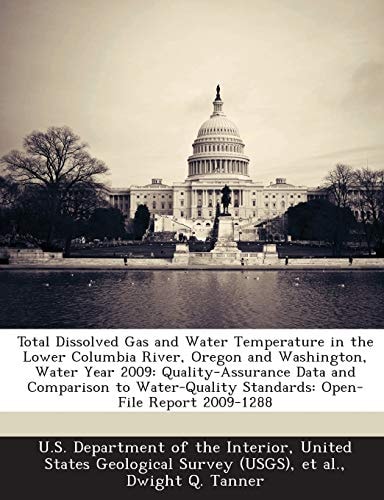
Total Dissolved Gas and Water Temperature in the Lower Columbia River, Oregon and Washington, Water Year 2009: Quality-Assurance Data and Comparison to Standards: Open-File Report 2009-1288
0
0
As an Amazon Associate and affiliate partner, Menrva Books earns from qualifying purchases. Learn more
Author Description
Significant Findings When water is released through the spillways of dams, air is entrained in the water, increasing the downstream concentration of dissolved gases. Excess dissolved-gas concentrations can have adverse effects on freshwater aquatic life. The U.S. Geological Survey (USGS), in cooperation with the U.S. Army Corps of Engineers, collected dissolved-gas and water-temperature data at eight monitoring stations on the lower Columbia River in Oregon and Washington in 2009. Significant findings from the data include: During the spill season of April through August 2009, hourly values of total dissolved gas (TDG) were occasionally larger than 115-percent saturation for the forebay stations (John Day navigation lock, The Dalles forebay, Bonneville forebay, and Camas). Hourly values of total dissolved gas were occasionally larger than 120-percent saturation for two tailwater stations (John Day Dam tailwater and Cascade Island). From mid- to late July to mid-September 2009, water temperatures were greater than 20 degree(s) C (degrees Celsius) at seven stations on the lower Columbia River. According to the State of Oregon temperature standard, the 7-day average maximum temperature of the lower Columbia River should not exceed 20 degree(s)C; Washington regulations state that the 1-day maximum should not exceed 20 degree(s) C as a re-sult of human activities. All 96 laboratory checks of the TDG sensors with a certified pressure gage were within 0.4 percent saturation after 3 to 4 weeks of deployment in the river. All but 2 of the 73 in situ field checks of TDG sensors with a secondary standard were within + or - (plus or minus) 1.0-percent saturation after 3-4 weeks of deployment in the river. All 74 of the field checks of barometric pressure were within + or - 2.0 millimeters of mercury of a secondary standard, and all 65 water-temperature field checks were within + or - 0.2 degree(s) C. For the eight monitoring stations in water year 2009, a total of 99.2 percent
Menrva's Summary
THE THESIS
This report investigates the levels of total dissolved gas (TDG) and water temperature in the Lower Columbia River during Water Year 2009, assessing their compliance with state standards and the quality of the collected data. Dwight Q. Tanner, a researcher with the U.S. Geological Survey (USGS), presents findings from data collected at eight monitoring stations in cooperation with the U.S. Army Corps of Engineers. The study utilized data collected throughout the year, with a particular focus on the spill season (April-August) and periods of elevated water temperature. The primary argument centers on the observed concentrations of TDG and water temperatures in relation to established environmental standards for aquatic life.
THE SCOPE MAP
- Total dissolved gas (TDG) and water temperature data collected at eight monitoring stations on the lower Columbia River.
- Analysis of TDG concentrations exceeding 115% and 120% saturation during the spill season.
- Water temperature data compared against Oregon and Washington state standards.
- Comprehensive quality-assurance data for TDG sensors and barometric pressure measurements.
- Detailed findings on the accuracy and reliability of the monitoring equipment.
THE AUTHORITY PERSPECTIVE
This USGS Open-File Report provides a detailed technical account of environmental monitoring data for the Lower Columbia River in 2009. The findings highlight instances where dissolved gas levels exceeded recommended thresholds and water temperatures approached or surpassed state standards, indicating potential impacts on aquatic ecosystems. The report also rigorously documents the quality assurance measures taken, demonstrating a high degree of confidence in the collected data and the reliability of the monitoring equipment.
Page Count:
38
Publication Date:
2013-02-05
Publisher:
BiblioGov
ISBN-10:
1288708084
ISBN-13:
9781288708086
Non-Fiction
Science
Science & Technology
Water Quality
Community Tags
Similar Books





Reader Comments
Share Your Thoughts
No comments yet. Be the first to share your thoughts!