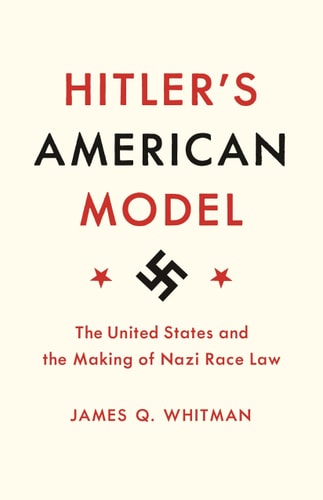
Hitler's American Model: The United States and the Making of Nazi Race Law
0
0
As an Amazon Associate and affiliate partner, Menrva Books earns from qualifying purchases. Learn more
Author Description
Nazism triumphed in Germany during the high era of Jim Crow laws in the United States. Did the American regime of racial oppression in any way inspire the Nazis? The unsettling answer is yes. In Hitler's American Model, James Whitman presents a detailed investigation of the American impact on the notorious Nuremberg Laws, the centerpiece anti-Jewish legislation of the Nazi regime. Contrary to those who have insisted that there was no meaningful connection between American and German racial repression, Whitman demonstrates that the Nazis took a real, sustained, significant, and revealing interest in American race policies. As Whitman shows, the Nuremberg Laws were crafted in an atmosphere of considerable attention to the precedents American race laws had to offer. German praise for American practices, already found in Hitler's Mein Kampf, was continuous throughout the early 1930s, and the most radical Nazi lawyers were eager advocates of the use of American models. But while Jim Crow segregation was one aspect of American law that appealed to Nazi radicals, it was not the most consequential one. Rather, both American citizenship and anti-miscegenation laws proved directly relevant to the two principal Nuremberg Laws--the Citizenship Law and the Blood Law. Whitman looks at the ultimate, ugly irony that when Nazis rejected American practices, it was sometimes not because they found them too enlightened, but too harsh. Indelibly linking American race laws to the shaping of Nazi policies in Germany, Hitler's American Model upends understandings of America's influence on racist practices in the wider world.
Menrva's Summary
THE THESIS
This book investigates the unsettling question of whether American racial oppression, particularly Jim Crow laws, influenced the development of Nazi race laws. James Q. Whitman, a legal scholar, meticulously examines the Nuremberg Laws, the cornerstone of Nazi anti-Jewish legislation, to demonstrate a direct and significant connection. The Nazis showed a sustained interest in American race policies, with prominent Nazi lawyers advocating for the adoption of American legal models. While segregation was noted, American citizenship and anti-miscegenation laws proved more directly consequential to the Nuremberg Laws, revealing an ironic dynamic where Nazi rejection of American practices sometimes stemmed from finding them too extreme.
THE SCOPE MAP
- Detailed investigation into the influence of American race laws on Nazi legislation, specifically the Nuremberg Laws.
- Analysis of American citizenship and anti-miscegenation laws as direct precedents for Nazi racial policies.
- Exploration of the historical period of Jim Crow in the United States and its contemporary relevance to Nazi Germany.
- Examination of primary sources and legal scholarship to support the thesis of American influence.
- Discussion of the ironic instances where Nazi radicals found American racial laws either too lenient or too harsh.
- Contextualization of Nazi racial ideology within the broader landscape of global racial practices in the early 20th century.
THE AUTHORITY PERSPECTIVE
The book is regarded as a significant and unsettling contribution to the understanding of historical racial policies. It challenges previous assumptions about the isolation of American and German racial repression, providing detailed evidence of direct influence. The work is noted for its rigorous legal and historical analysis, linking specific American laws to the crafting of Nazi legislation. This scholarship compels a re-evaluation of America's global impact on racist practices.
Page Count:
232
Publication Date:
2018-09-04
Publisher:
Princeton University Press
ISBN-10:
0691183066
ISBN-13:
9780691183060
Politics
Non-Fiction
History
Law
Community Tags
Similar Books